Digital art has modified how artists create and express themselves. Traditional flat canvases have given way to immersive three-dimensional worlds that feel real to the touch.
Yet many people still wonder what is 3D art is and what it involves, and how it differs from regular digital drawing.
This guide will break down everything about 3D art in simple terms. You’ll learn what tools artists use, how they build virtual sculptures, and why this art form has become so popular.
We’ll also see different types of 3D artwork, from animated movies to video game characters.
By the end, you’ll understand how 3D artists bring their imagination to life using computer software. Plus, you’ll know enough to start your own 3D art projects if you’re interested.
How Digital Creativity Comes to Life with 3D Art?
3D art is digital artwork created with depth, width, and height using computer software. Unlike flat 2D images, these creations can be viewed and rotated from any angle, like virtual sculptures.
What makes 3 dimensional art unique:
- Three dimensions: Has volume and depth, not just flat surfaces
- Realistic lighting: Shadows and highlights behave naturally
- Multiple viewpoints: Can be seen from every angle
- Animation ready: Objects can move and transform
- Interactive potential: Viewers can see the artwork
3D art appears everywhere today. Video games use it for characters and worlds. Movies create stunning visual effects. Architects design buildings before they’re built.
Even social media filters rely on 3D technology. The main appeal is creative freedom. Artists can build anything imaginable, from realistic people to impossible fantasy worlds.
This makes 3D art both exciting and accessible for beginners and professionals alike.
Why 3D Art Matters Today
3 Dimensional art has revolutionized how we communicate ideas and solve problems. From medical students studying virtual organs to urban planners visualizing entire cities, this technology makes complex concepts easier to understand.
The business world depends on 3D for competitive advantages. Product designers test concepts without expensive physical prototypes. Marketing teams create engaging campaigns that capture attention in crowded digital spaces.
Training programs use 3D simulations to prepare workers for dangerous or complex tasks safely.
Entertainment consumption patterns show why 3D matters. Streaming platforms invest billions in 3D-animated content. Gaming revenues now exceed traditional Hollywood box office earnings, driven largely by immersive 3D experiences.
The technology democratizes creativity, too. Small businesses can now produce professional-quality visuals that once required expensive studios. Independent creators build massive online followings using accessible 3D tools.
Educational institutions teach 3D skills to prepare students for future job markets where these abilities are increasingly required across multiple fields
From Ancient Sculptures to Digital Worlds: The Evolution of 3D Art
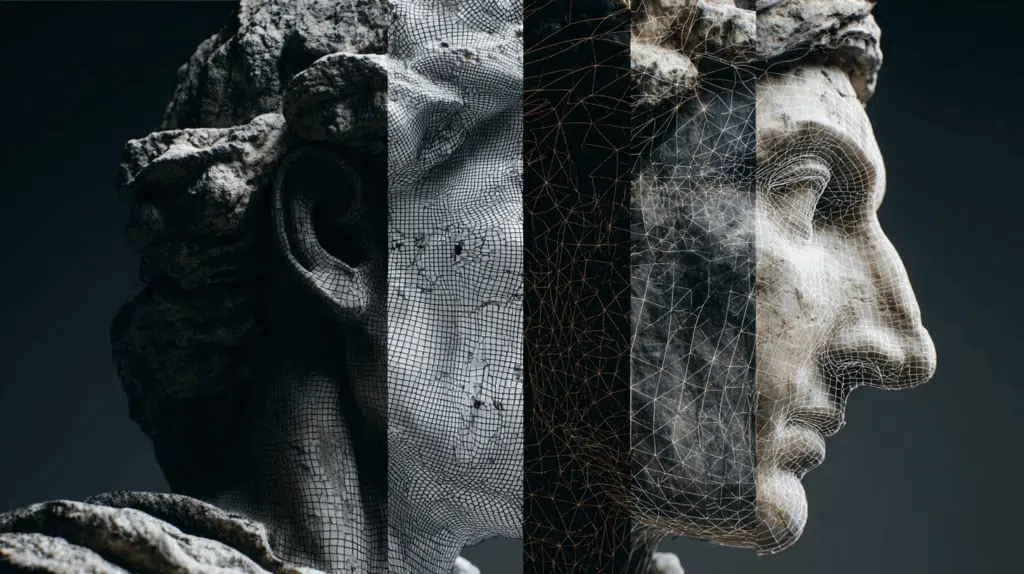
The path from chisel-carved marble to computer-generated worlds spans thousands of years of human creativity.
This evolution shows how artists have always sought to create depth and dimension, with technology simply providing new tools for age-old artistic ambitions.
From Prehistoric Caves to Digital Studios
The concept of creating three-dimensional art isn’t new. Ancient sculptors carved marble statues and crafted pottery with depth and form.
What changed is the medium. Instead of chisels and clay, modern artists use computers and software.
The Digital Revolution Begins
3D computer graphics started in the 1960s at universities and research labs. Early pioneers created simple wireframe models that looked like geometric skeletons.
These basic shapes eventually evolved into the photorealistic characters and environments we see today.
Key milestones in 3D art evolution:
- 1970s: First 3D computer graphics appear in films
- 1980s: Personal computers make 3D tools more accessible
- 1990s: Movies like Toy Story prove 3D animation’s commercial potential
- 2000s: Gaming industry drives major advances in real-time 3D
- 2010s: Mobile devices bring 3D to everyday users
- Today: AI and cloud computing push new creative boundaries
Modern Impact and Accessibility
What once required expensive workstations now runs on laptops. Free software puts professional-grade 3D tools in anyone’s hands.
Online tutorials teach complex techniques to millions worldwide. This democratization means 3D art continues evolving faster than ever before.
The art form that started with simple wireframes now creates entire virtual worlds indistinguishable from reality.
The Ultimate Showdown: 3D Art vs 2D Art
Understanding the differences between 3D and 2D art helps clarify what makes each medium unique. Both have their strengths and serve different creative purposes.
| Aspect | 2D Art | 3D Art |
|---|---|---|
| Dimensions | Height and width only | Height, width, and depth |
| Viewing Angle | Single fixed perspective | Multiple angles and viewpoints |
| Creation Tools | Brushes, pens, digital tablets | 3D modeling software, sculpting tools |
| File Types | JPEG, PNG, GIF | OBJ, FBX, STL |
| Learning Curve | Moderate to advanced | Steep, requires technical knowledge |
| Rendering Time | Instant to minutes | Minutes to hours |
| Storage Space | Small file sizes | Large file sizes |
| Animation | Frame-by-frame drawing | Rigging and keyframe animation |
| Lighting | Painted or drawn manually | Calculated by software |
| Textures | Hand-painted details | Applied material maps |
| Industry Use | Illustration, graphic design, web | Gaming, films, architecture, and product design |
| Cost | Lower software and hardware costs | Higher system requirements |
Both art forms complement each other in modern creative workflows. Many projects combine 2D and 3D elements to achieve the best visual results.
Get to Know About The Types of 3 Dimensional Art

Three-dimensional art comes in many forms, each serving different creative and practical purposes.
From character animation that brings movies to life to architectural models that help design future buildings, understanding these categories reveals the vast scope of 3D creativity.
Modeling and Sculpting
Digital modeling involves building 3D objects from basic shapes like cubes and spheres.
Artists stretch, bend, and combine these forms to create everything from furniture to spaceships.
Digital sculpting works more like traditional clay work, where artists push and pull virtual material to shape organic forms like faces and creatures.
Animation and Motion Graphics
3D animation brings static models to life through movement. Character animators create walking cycles and facial expressions for movies and games.
Motion graphics designers craft flying logos and spinning product showcases for commercials and presentations.
Architectural Visualization
Architects and interior designers use 3D art to show buildings before construction begins. These visualizations help clients understand spatial relationships and design choices. Virtual walkthroughs allow people to see rooms and buildings as if they were physically present.
Product Design and Prototyping
Companies design cars, phones, and household items in 3D before manufacturing. This process saves money by catching design flaws early.
Prototypes can be tested virtually for functionality and aesthetics without building physical versions.
Gaming and Interactive Media
Video game environments require specialized 3D art optimized for real-time performance. Artists create characters, weapons, and worlds that players can interact with instantly.
This type of 3D art prioritizes efficiency over photorealism to maintain smooth gameplay.
Medical and Scientific Visualization
Healthcare professionals use 3D models to study anatomy and plan treatments. Scientific researchers create molecular structures and astronomical phenomena that help explain complex concepts to students and colleagues.
Tools, Techniques, and Software Used in 3D Art
| Category | Examples | Purpose in 3D Art |
|---|---|---|
| 3D Modeling Software | Blender, Maya, 3ds Max, Cinema 4D | Building objects, characters, and environments with polygons and meshes. |
| Sculpting Tools | ZBrush, Mudbox | Creating organic shapes and fine details, similar to digital clay sculpting. |
| Rendering Engines | V-Ray, Arnold, Octane, Cycles | Converting 3D models into realistic images with lighting, shadows, and textures. |
| Animation Software | Maya, Houdini, Blender | Adding movement, physics, and storytelling to 3D creations. |
| Texturing & Painting Tools | Substance Painter, Photoshop, Mari | Designing and applying surface details, colors, and patterns to 3D models. |
| Lighting Techniques | Three-point lighting, HDRI, global illumination | Improving depth, mood, and realism through digital light placement. |
| Rendering Techniques | Ray tracing, rasterization, and real-time rendering | Producing lifelike visuals or optimized game graphics. |
| Hardware Tools | Graphic tablets, VR headsets, and GPUs | Supporting creative control, immersive design, and faster rendering performance. |
The Bottom line
3D art has evolved from experimental computer graphics into an essential creative medium that shapes our digital world. This technology now influences everything from the movies we watch to the products we buy online.
What is 3D art? Understanding it helps appreciate the skill behind animated characters and its practical uses in healthcare and architecture.
As virtual and augmented reality become mainstream, 3D literacy becomes increasingly valuable.
What’s next? Consider trying free 3D software like Blender to create your own models. Even basic knowledge opens doors to exciting career opportunities in gaming, film, and design.
The boundary between digital and physical continues to blur. 3D art isn’t just changing how we create, it’s modifying how we experience and interact with the world around us.