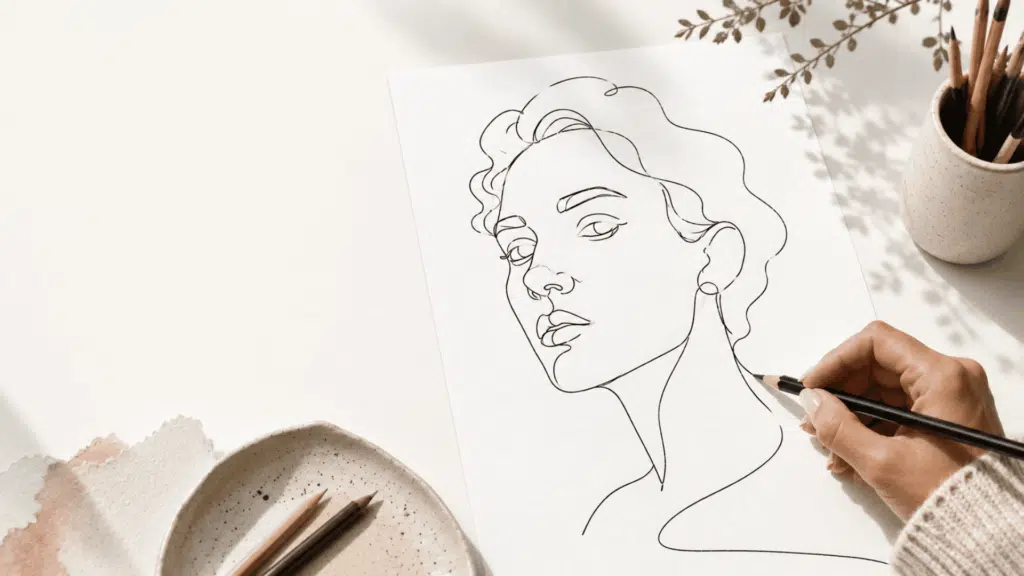
Contour drawing may look simple at first, but it reveals how artists truly see the world. With only lines and careful observation, ordinary objects begin to feel more alive and mysterious.
Artists use it to improve focus, coordination, and observation skills.
Blind contour and continuous line exercises make simple shapes feel more expressive, challenging, and interesting to draw.
What Is Contour Drawing?
It is a foundational art technique that focuses on capturing the visible edges, shapes, and outlines of a subject without shading or heavy detail.
Artists use slow, careful observation to translate what they see directly onto paper.
This method strengthens hand-eye coordination, improves observation skills, and trains artists to notice proportions and form more accurately.
Blind contour drawing, a variation of the technique, involves drawing without looking at the paper, helping build focus and visual awareness.
Contour Drawing vs Gesture Drawing
It improves observation and accuracy, while gesture drawing captures movement and expression. Practicing both strengthens overall drawing skills.
| TECHNIQUE | FOCUS | BEST USED FOR |
|---|---|---|
| Contour Drawing | Form, outlines, and edges | Improving observation, accuracy, and hand-eye coordination |
| Gesture Drawing | Movement, flow, and energy | Capturing action, poses, and overall motion quickly |
Types of Contour Drawing
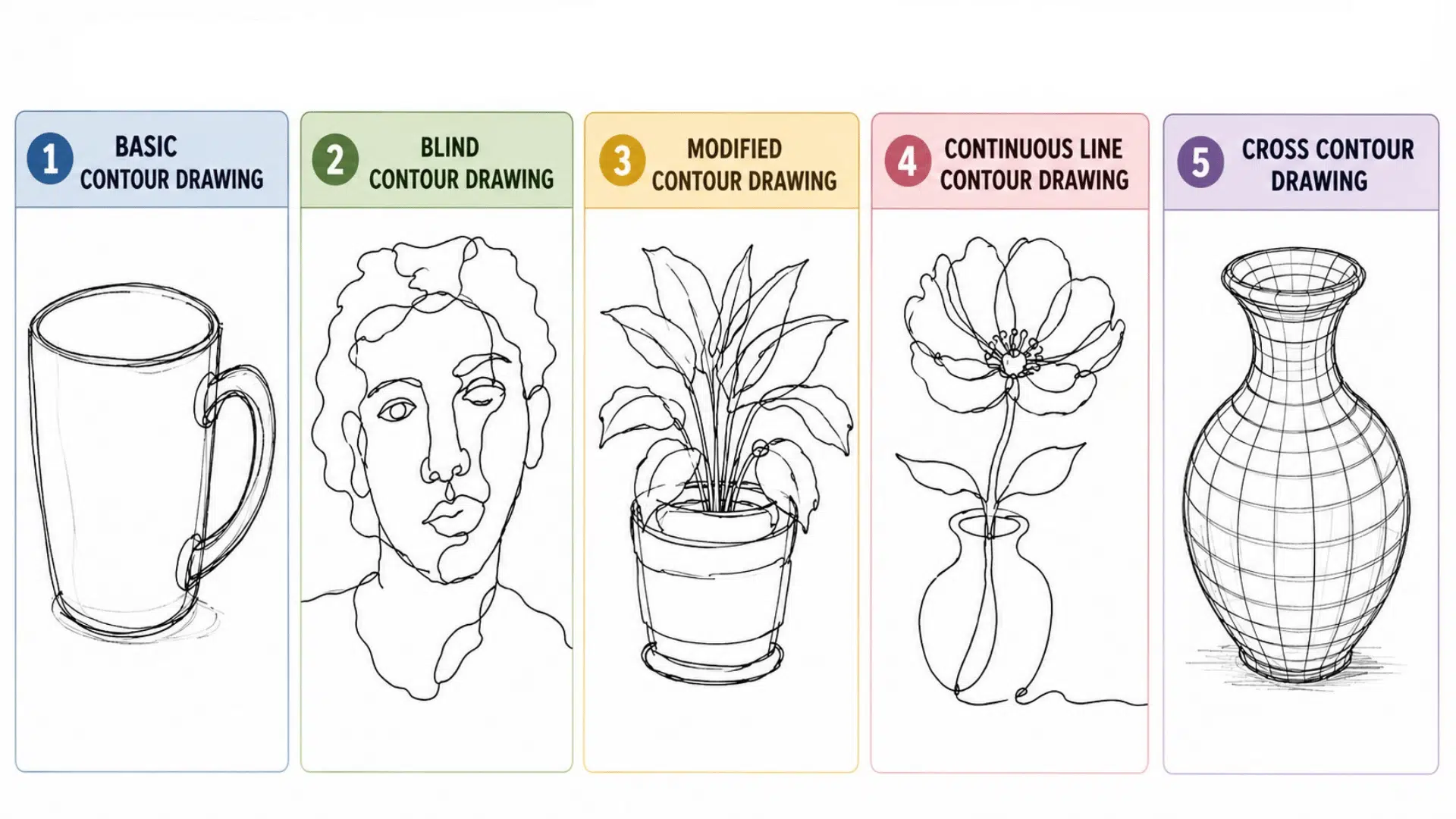
It includes different techniques that help artists improve observation, line control, and understanding of shapes. Each style develops unique skills and builds confidence.
1. Basic Contour Drawing
It focuses on carefully sketching the outer edges and visible outlines of a subject. It is ideal for beginners learning proportion, shape recognition, and hand-eye coordination.
This technique trains artists to slow down and observe details more accurately. It also builds a strong foundation for realistic sketching and object studies.
Example: Sketching a coffee mug using simple outlines.
2. Blind Contour Drawing
It involves drawing a subject without looking at the paper, following the “no peeking” rule. This continuous line technique strengthens observation skills and visual focus.
Although the results may appear distorted, the exercise improves concentration and helps artists draw what they truly see instead of what they assume.
Example: Drawing your hand without viewing the paper.
3. Modified Contour Drawing
It allows artists to occasionally glance at the paper while drawing. It offers an easier transition for beginners practicing contour line drawing techniques.
This method balances observation with control, making it less intimidating than blind contour drawing. It also gradually improves line placement and proportions.
Example: Sketching fruits while checking the paper occasionally.
4. Continuous Line Contour Drawing
It is created without lifting the pen from the paper. This method improves line flow, confidence, and smoother sketching movements.
Artists often use this technique to create expressive and fluid drawings with a natural rhythm. It also encourages more decisive and confident strokes.
Example: Drawing a face using one uninterrupted line.
5. Cross Contour Drawing
It uses internal contour lines to show depth, volume, and surface form. It is commonly used by advanced artists to create more dimensional drawings.
These contour lines wrap around the object’s shape, helping viewers understand structure and perspective. It is especially useful for figure drawing and complex forms.
Example: Adding curved lines across a rounded vase.
Step-by-Step on How to Do Contour Drawing
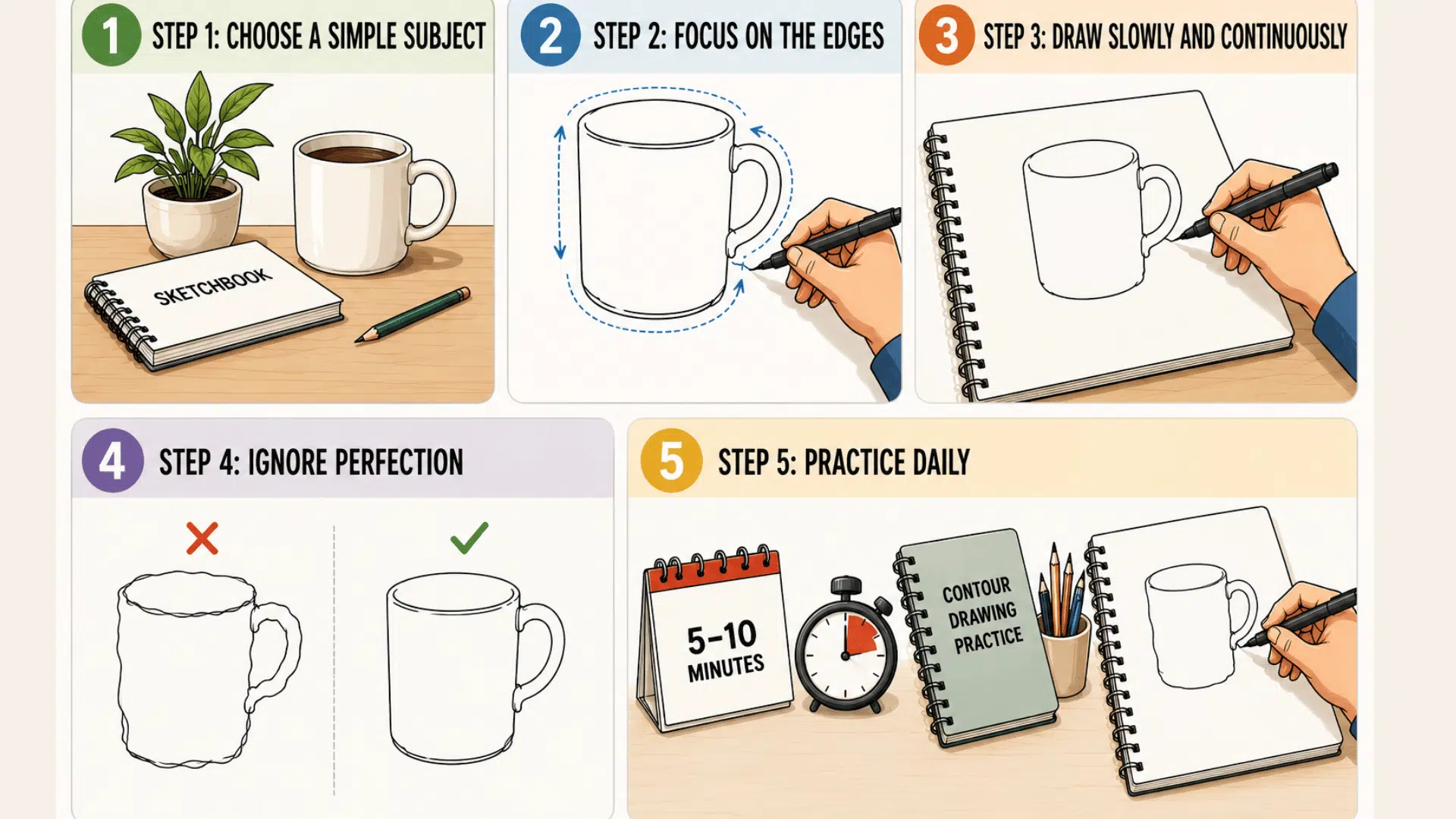
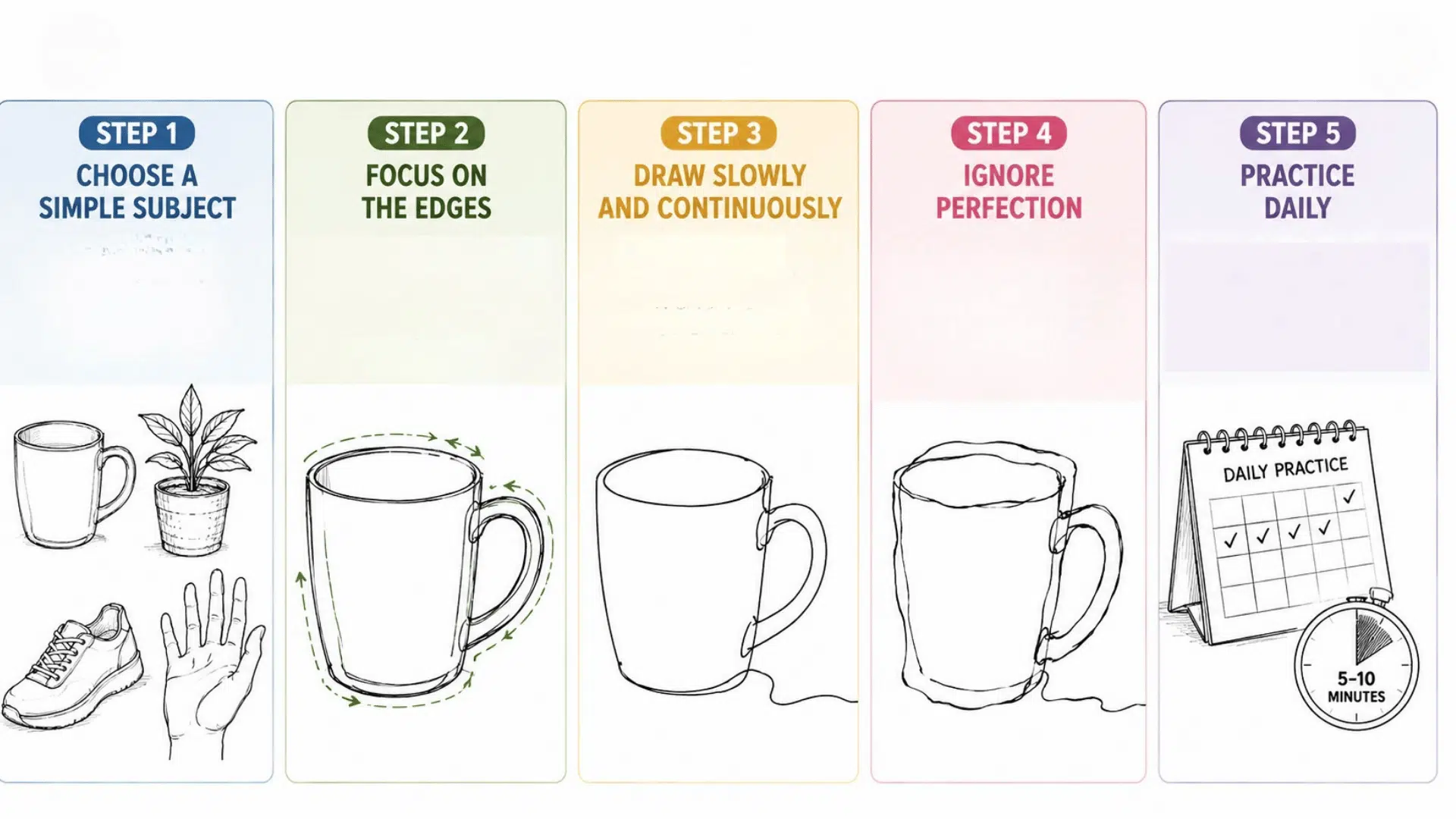
Learning it becomes easier when you break the process into simple steps. These exercises help artists improve observation, line control, and confidence through consistent practice and careful visual focus.
Step 1: Choose a Simple Subject
Start with simple, recognizable objects like hands, coffee mugs, plants, shoes, or faces. These are easier to observe, helping beginners focus on contour line drawing without feeling overwhelmed.
Simple objects also allow artists to practice proportions and outlines more comfortably. As confidence improves, you can move on to more detailed or complex subjects.
Step 2: Focus on the Edges
Train your eyes to slowly follow the outer edges and contours of the subject while drawing. Instead of thinking about the entire object, concentrate on tracing the outline visually with careful attention.
This technique improves observation skills and helps artists notice small curves, angles, and shape changes. It also strengthens hand-eye coordination over time.
Step 3: Draw Slowly and Continuously
Use slow, steady lines instead of short or sketchy strokes. Continuous contour drawing works best when artists move the pen smoothly while carefully observing the subject.
Drawing slowly encourages accuracy and patience while reducing rushed mistakes. The goal is to observe carefully rather than finish quickly.
Step 4: Ignore Perfection
Distorted or uneven drawings are completely normal during drawing practice, especially with blind contour line drawing exercises. The purpose is to improve observation, not create a perfect artwork.
Accepting mistakes helps build confidence and reduces fear of failure. Over time, regular practice naturally improves accuracy and line quality.
Step 5: Practice Daily
Short daily sessions of 5 to 10 minutes can significantly improve drawing skills. Regular practice strengthens observation, muscle memory, and drawing confidence much faster than occasional long sessions.
Beginners can also combine it with beginner sketching tutorials or simple drawing exercises to develop stronger overall art fundamentals.
What Is Blind Contour Drawing and How Does It Improve Drawing Skills?
It is a simple art exercise: draw a subject without looking at your paper.
Popularized by artists and teachers like Betty Edwards and Kimon Nicolaïdes, this technique helps improve observation and concentration.
Instead of focusing on perfect results, artists carefully track the subject’s edges with their eyes as they draw slowly.
It strengthens hand-eye coordination, reduces perfectionism, and improves visual awareness. Beginners often practice with hands, faces, plants, shoes, and everyday household objects.
Easy Contour Drawing Exercises for Beginners
These exercises help beginners build observation skills, line control, and confidence. They also train artists to see shapes, edges, and proportions more accurately.
1. 1-Minute Contour Drawings
This beginner exercise involves creating quick contour sketches within one minute. It works as a simple warm-up that improves focus and helps artists loosen up before longer drawing sessions.
Short-term drawings also train faster observation skills and reduce the pressure to create perfect artwork. They are ideal for daily practice routines.
2. Blind Contour Hand Drawing
Blind contour hand drawing is a classic art-school exercise where artists draw their hand without looking at the paper. This technique strengthens observation and hand-eye coordination.
It also teaches beginners to slow down and carefully follow edges rather than rely on memory. Distorted results are completely normal during practice.
3. Continuous Line Self-Portraits
Continuous line self-portraits are created without lifting the pen from the paper. This intermediate exercise helps artists build confidence, creativity, and smoother line movement.
The exercise encourages expressive drawing while improving concentration and visual awareness. It also helps artists become more comfortable with imperfections.
4. Drawing Everyday Objects
Simple household items like keys, glasses, cups, and headphones make excellent it subjects for beginners. Their familiar shapes are easier to observe and sketch carefully.
Drawing everyday objects improves shape recognition and contour line accuracy. It also helps artists practice regularly using objects available at home.
5. Upside-Down Contour Drawing
It is an advanced exercise that involves copying an upside-down image. This method trains the brain to focus on shapes and lines instead of recognizable symbols.
The exercise improves observation skills and helps artists notice details they often overlook. It is especially useful for improving drawing accuracy and concentration.
Best Tools for Contour Drawing
The right tools improve line control, comfort, and sketch quality. Beginners can start simple, while advanced artists may explore professional and digital tools.
| Tool Category | Best Options | Benefits |
|---|---|---|
| Pens vs Pencils | Fine liners, graphite pencils | Pens improve confident lines, while pencils allow easy corrections |
| Sketchbooks | Smooth paper sketchbooks | Great for daily practice and line exercises |
| Digital Drawing Tools | Drawing tablets, stylus pens | Helpful for digital contour line drawing and creative flexibility |
| Beginner Supplies | Brush pens, erasers, rulers | Simple tools that support beginner sketching and observation practice |
Tips to Improve Your Contour Drawings
Improving it takes patience, observation, and regular practice. Small changes in how you observe and draw can greatly improve line quality, confidence, and overall drawing accuracy over time.
- Draw What You Actually See: Focus on the real edges, curves, and proportions of the subject instead of drawing from memory or assumptions.
- Slow Down Your Eye Movement: Move your eyes carefully along the subject’s outline as you draw slowly. This improves observation and hand-eye coordination.
- Practice Daily Without Judging Results: Short daily sessions help build confidence and reduce perfectionism. Mistakes are a normal part of learning.
- Use Continuous Lines and Study Real-Life Objects: Practice continuous drawing and observe real-life objects instead of photos to improve natural line flow and visual awareness.
Wrapping It Up
It helps artists improve observation, line control, and drawing confidence. By focusing on shapes and edges, artists learn to draw more naturally and accurately.
Each drawing exercise helps improve drawing skills over time.
It also teaches patience and creative freedom, making it valuable for both beginners and experienced artists who want to strengthen the connection between the eye and the hand.