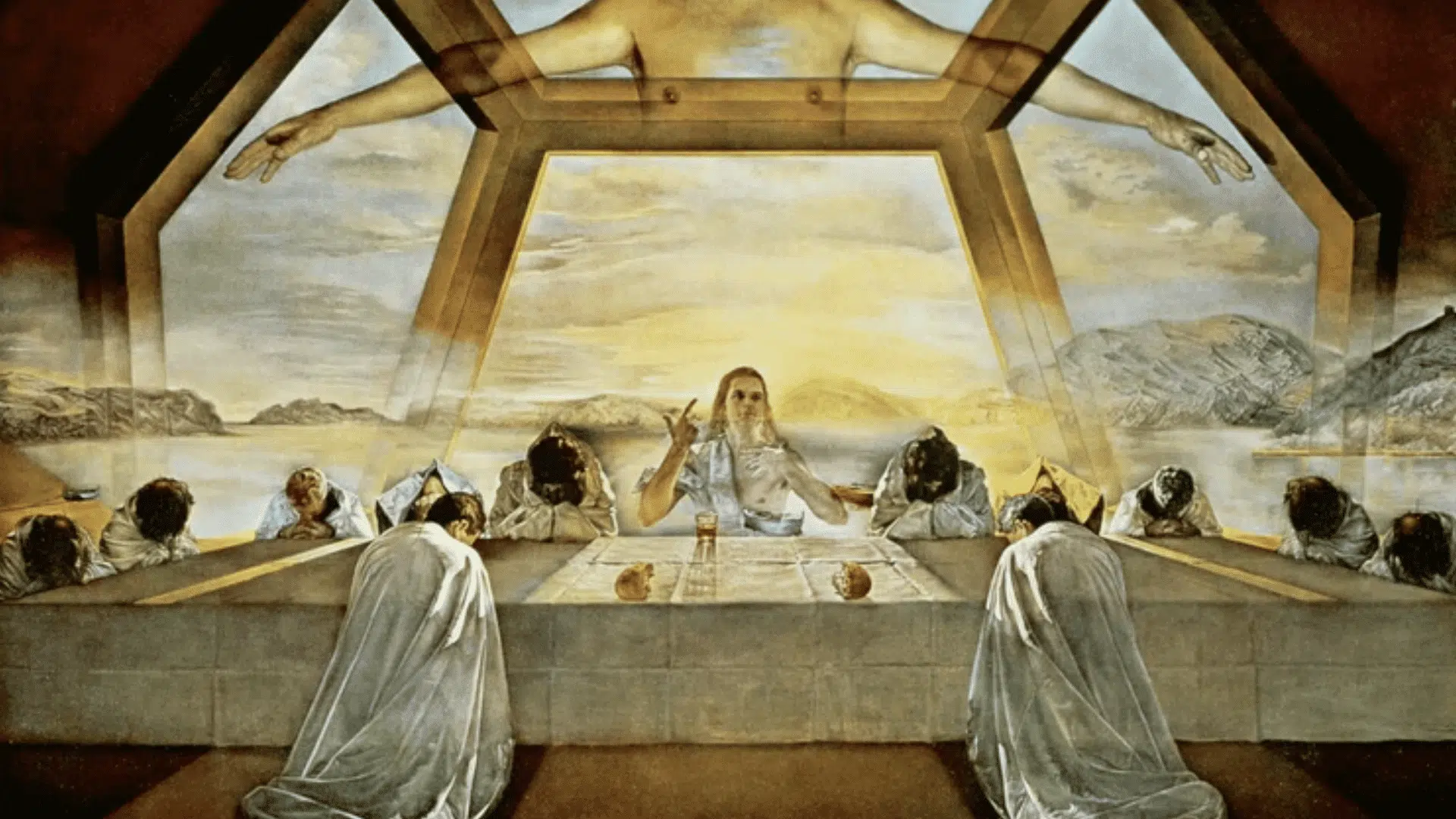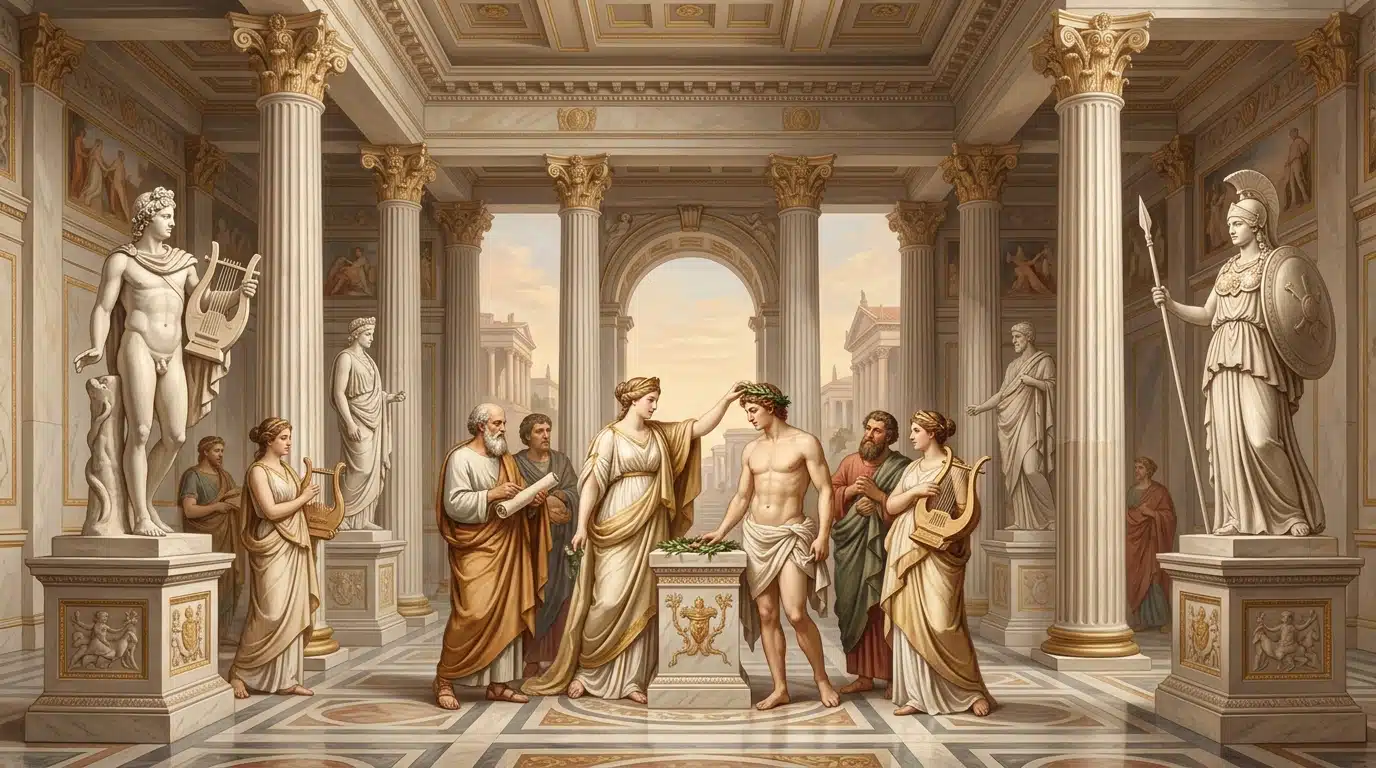

Some paintings stop you in your tracks. They whisper secrets from centuries ago, making your heart race. The best art of all time doesn’t just hang on museum walls; it lives in our memory.
From da Vinci’s mysterious smile to Starry Night’s swirling skies, certain masterpieces transcend their frames.
What separates legendary paintings from forgotten ones? They capture something beyond beauty, a feeling that lives in your chest but never finds words.
What Defines the Greatest Works of Art?
Great art isn’t just about being pretty or expensive. The best artworks share some key qualities that make them unforgettable.
- First: They connect with people emotionally; they make you feel deeply.
- Second: They show incredible skill and creativity that takes years to master.
- Third: They often break the rules or introduce new ideas that change how we see the world.
The most significant pieces also stand the test of time, staying relevant for hundreds or even thousands of years.
They tell stories, capture moments, and reflect their culture. Most importantly, masterpieces inspire artists and people. Truly great art makes you stop. You know it.
Artworks That Shaped Artistic History
Throughout history, some pieces have become icons, representing the best art and leaving a lasting cultural mark. These artworks changed everything.
1. Mona Lisa

Source: smarthistory.org
Leonardo da Vinci’s portrait, with its mysterious smile and sfumato technique, creates an incredibly lifelike presence.
Her gaze follows you around the room, creating an intimate connection that has intrigued millions for over five centuries. This painting stands firmly among the best works of art of all time.
- Art Movement: High Renaissance
- Date:1503–1506
- Medium: Oil on poplar panel
- Location: Louvre Museum, Paris
2. The Starry Night

Source: sanctuarymentalhealth.org
Van Gogh captured this swirling sky beautifully from his window at the asylum in Saint-Rémy-de-Provence, giving us a glimpse into his incredible vision and artistry.
The bold, turbulent brushstrokes and lively blues convey deep emotion and inner turmoil, while a quiet village rests below the cosmic drama above.
- Art Movement: Post-Impressionism
- Date: 1889
- Medium: Oil on canvas
- Location: Museum of Modern Art, New York
3. The Last Supper

Source: wikipedia.org
Da Vinci’s monumental mural captures the dramatic moment Christ announces his betrayal during Passover. Each of the twelve apostles reacts differently: shock, anger, and confusion.
Perspective lines converge on Christ’s head, making him the undeniable focal point of this sacred scene.
- Art Movement and Date: Late 15th Century
- Date: 1495–1498
- Medium: Tempera and oil on plaster
- Location: Santa Maria delle Grazie, Milan
4. David

Source: mymodernmet
Michelangelo carved this 17-foot marble giant to embody human perfection and courage before battle.
David’s tense muscles, furrowed brow, and focused gaze capture the moment before facing Goliath, all concentration and coiled energy.
- Art Movement: Renaissance
- Date: 1504
- Medium: Marble sculpture
- Location: Galleria dell’Accademia, Florence
5. Guernica

Source: pablopicasso.org
Picasso’s monumental canvas confronts the horrors of war with stark black, white, and gray imagery. Created in response to the bombing of a Spanish town during the Civil War.
It screams with anguish, distorted faces, a mother holding her dead child, a horse pierced by a spear. Fractured bodies and chaotic composition mirror the violence of modern warfare. This is among the best works of art of all time.
- Art Movement: Modern
- Date: 1937
- Medium: Oil on canvas
- Location: Museo Reina Sofía, Madrid
6. The Persistence of Memory

Source: artshortlist
Dalí’s melting clocks drape over a barren landscape like soft cheese. The surreal scene combines precision with impossibility. Complex objects become fluid, and time becomes meaningless.
A strange, fleshy creature (possibly a self-portrait) lies at the center, distorted by time as well.
- Art Movement: Surrealism
- Date: 1931
- Medium: Oil on canvas
- Location: Museum of Modern Art, New York
7. Girl with a Pearl Earring

Source: wikipedia.org
Vermeer’s intimate portrait captures a fleeting moment with luminous charm and technical mastery. The girl’s exotic turban and oversized pearl earring create a sense of mystery against a dark, featureless background.
Her direct gaze and parted lips suggest she’s about to speak, frozen forever in that expectant moment. The way light catches her face and the pearl demonstrates why this belongs among the best art of all time.
- Art Movement: Dutch Golden Age
- Date: 1665
- Medium: Oil on canvas
- Location: Mauritshuis, The Hague
8. The Scream

Source: nytimes
Munch’s anguished figure stands on a bridge under a blood-red sky, hands pressed to face in existential dread. The wavy, distorted landscape amplifies the central figure’s silent howl; even nature seems to vibrate with anxiety.
This painting has become a universal symbol of human emotion, capturing the raw essence of fear and isolation that transcends time.
- Art Movement: Expressionism
- Date: 1893
- Medium: Oil, tempera, pastel, and crayon on cardboard
- Location: National Museum, Oslo
9. Las Meninas

Source: Britannica
Velázquez created a complex visual puzzle that blurs the lines between viewer and subject in this royal portrait. The artist includes himself at his easel, painting the king and queen who appear only as reflections.
Young Princess Margarita stands at the center surrounded by her maids of honor, while courtiers occupy various depths. Mirrors, perspectives, and layered gazes make one of the best works of art of all time.
- Art Movement: Baroque
- Date: 1656
- Medium: Oil on canvas
- Location: Prado Museum, Madrid
10. The Birth of Venus

Source: uffizi.it
Botticelli’s goddess emerges from the sea atop a giant scallop shell, carried ashore by the wind gods.
The flowing lines and delicate colors create an almost dreamlike quality. Venus’s long hair and the fabric swirling around her seem weightless. Her contrapposto pose and modest gesture echo classical sculpture.
- Art Movement: Early Renaissance
- Date: 1485
- Medium: Tempera on canvas
- Location: Uffizi Gallery, Florence
11. The Night Watch

Source: BBC
Rembrandt revolutionized group portraits by capturing his militia company in dramatic motion rather than stiff formation.
Captain Frans Banning Cocq strides forward, his hand extended, while his lieutenant walks beside him in bright yellow. Figures emerge from and recede into shadow, creating theatrical depth.
- Art Movement: Baroque
- Date: 1642
- Medium: Oil on canvas
- Location: Rijksmuseum, Amsterdam
12. Water Lilies

Source: metmuseum.org
Monet’s massive panels immerse viewers in his garden pond at Giverny, eliminating horizon lines. The reflections, dappled light, and floating flowers blur boundaries between water and sky, between surface and depth.
These late works, painted despite failing eyesight, represent the best art of all time, as Impressionism explores pure perception.
- Art Movement: Impressionism
- Date: early 1900s
- Medium: Oil on canvas
- Location: Musée de l’Orangerie, Paris
13. American Gothic

Source: wikipedia.org
Grant Wood’s stern farmer stands beside his daughter (often mistaken for his wife) in front of their Gothic Revival farmhouse.
Careful attention to detail and straight, vertical lines beautifully reflect the wholesome values of rural Midwest communities.
- Art Movement: Regionalism
- Date: 1930
- Medium: Oil on beaverboard
- Location: Art Institute of Chicago
14. The Kiss

Source: pomegranate
Klimt wrapped his embracing lovers in ornate golden patterns that seemed to merge them into a single decorative form. The man bends to kiss the woman, who kneels with eyes closed and face tilted in blissful surrender.
Gold leaf, geometric patterns for him, circular flowers for her, even their clothing suggests masculine and feminine principles uniting.
- Art Movement: Art Nouveau
- Date: 1908
- Medium: Oil and gold leaf on canvas
- Location: Belvedere Museum, Vienna
15. A Sunday Afternoon on the Island of La Grande Jatte

Source: frenchquest
Seurat spent two years applying thousands of tiny colored dots to create this Parisian park scene. His pointillist technique uses optical mixing, where the eye blends the dots into coherent forms and colors.
The formal, frozen quality of the strolling figures gives the leisurely scene a distinct, timeless feel, making it among the best works of art of all time.
- Art Movement: Post-Impressionism
- Date: 1884–1886
- Medium: Oil on canvas
- Location: Art Institute of Chicago
16. The Garden of Earthly Delights

Source: artsy.net
Bosch’s massive triptych presents paradise, earthly pleasures, and hell in bizarre, fantastical detail across three panels. Strange hybrid creatures, impossible architecture, and surreal scenarios fill every inch.
The right panel’s hell contains musical instruments transformed into torture devices.
- Art Movement: Northern Renaissance
- Date: 1500
- Medium: Oil on oak panels
- Location: Prado Museum, Madrid
17. The School of Athens

Source: hum120.wordpress
Raphael gathered history’s greatest thinkers in an imaginary classical hall with perfect perspective and noble proportions.
Plato and Aristotle stand at the center, one pointing up to ideal forms, the other gesturing down to earthly reality. Mathematicians, astronomers, and philosophers fill the space in animated discussion.
- Art Movement and Date: High Renaissance
- Date: 1511
- Medium: Fresco
- Location: Vatican Museums, Rome
18. The Creation of Adam

Source: queerarthistory
Michelangelo’s ceiling fresco shows God reaching across space to give Adam the glimpse of life with nearly-touching fingertips. That tiny gap between their hands has become one of art’s most recognizable images.
Symbolizing the connection between human and divine, the influential, muscular figures and dramatic moments define Renaissance humanism and are among the most significant works for iconic composition.
- Art Movement: Renaissance
- Date: 1512
- Medium: Fresco
- Location: Sistine Chapel, Vatican City
19. Whistler’s Mother

James McNeill Whistler’s portrait shows his mother sitting in strict profile against a gray wall. The restrained palette of grays and blacks emphasizes quiet contemplation and maternal dignity.
A simple curtain and print on the wall provide minimal decoration.
- Art Movement: Realism
- Date: 1871
- Medium: Oil on canvas
- Location: Musée d’Orsay, Paris
20. Liberty Leading the People

Source: artincontext.org
Delacroix painted bare-breasted Liberty as a fierce woman charging forward over fallen bodies and smoking barricades.
She holds the French tricolor high in one hand, a musket in the other, leading citizens from all classes in revolutionary fervor. A street urchin with pistols, a bourgeois with a top hat, and workers surge forward behind her.
- Art Movement and Date: Romanticism
- Date:1830
- Medium: Oil on canvas
- Location: Louvre Museum, Paris
21. Impression, Sunrise

Source: Claude-Monet
Monet’s loose, hazy harbor scene at Le Havre gave Impressionism its name, originally meant as mockery by critics. The orange sun breaks through morning mist, its reflection shimmering on water rendered in brushstrokes.
Small boats become dark silhouettes against the glowing atmosphere. This painting represents the best art of all time for launching an entire movement.
- Art Movement: Impressionism
- Date: 1872
- Medium: Oil on canvas
- Location: Musée Marmottan Monet, Paris
22. The Raft of the Medusa

Source: smarthistory.org
Géricault depicted the horrifying aftermath of a famous shipwreck where 147 survivors crowded onto a raft, enduring starvation and cannibalism.
The massive canvas shows desperate figures spotting rescue on the horizon. Muscular bodies pile across the diagonal composition.
- Art Movement: Romanticism
- Date: 1819
- Medium: Oil on canvas
- Location: Louvre Museum, Paris
23. Les Demoiselles d’Avignon

Source: pbs.org
Picasso shattered traditional representation with five angular, aggressive female figures staring confrontationally at viewers.
The fractured perspectives show faces from multiple angles simultaneously. Pink flesh tones clash with geometric blue drapery in this radical departure that announced Cubism’s arrival.
- Art Movement: Proto-Cubism
- Date: 1907
- Medium: Oil on canvas
- Location: Museum of Modern Art, New York
24. Self-Portrait with Thorn Necklace and Hummingbird

Source: hrc.utexas.edu
Frida Kahlo stares directly at viewers with characteristic intensity while thorns pierce her neck and blood drips down.
A dead hummingbird, a Black cat, and a monkey flank her among lush tropical leaves, creating a jungle of symbols.
- Art Movement: 20th Century
- Date: 1940
- Medium: Oil on canvas
- Location: Harry Ransom Center, Texas
25. Campbell’s Soup Cans

Source: moma.org
Warhol displayed 32 canvases of soup cans in a grid, each representing a different flavor variety available in stores. The repetitive commercial imagery is rendered with mechanical precision.
This work stands out for defining Pop Art and commenting on mass production and consumer culture.
- Art Movement: Pop Art
- Date: 1962
- Medium: Synthetic polymer paint on canvas
- Location: Museum of Modern Art, New York
26. The Great Wave off Kanagawa

Source: artsoullifemagazine
Hokusai’s woodblock print shows a towering wave threatening three boats, its claw-like foam reaching toward tiny Mount Fuji in the background.
The dramatic composition and distinctive flattened perspective influenced countless Western artists. Bold Prussian blue and white create a striking contrast.
- Art Movement: Edo Period
- Date:1831
- Medium: Woodblock print
- Location: Various Collections
27. No. 5, 1948

Source: jackson-pollock.org
Pollock dripped, poured, and splattered paint across his canvas in energetic layers, working on the floor rather than an easel.
The chaotic surface contains no recognizable forms, just pure gestural energy frozen in overlapping webs of color. This stands among the best art of all time for redefining what painting could be.
- Art Movement: Abstract Expressionism
- Date: 1948
- Medium: Oil on fiberboard
- Location: Private Collection
28. The Hay Wain

Source: BBC
Constable painted his native English countryside with fresh immediacy: a wagon crossing the stream by Flatford Mill, a rural cottage, towering clouds.
The outdoor observations and naturalistic light were radical departures from studio-composed landscapes.
- Art Movement: Romanticism
- Date: 1821
- Medium: Oil on canvas
- Location: National Gallery, London
29. The Arnolfini Portrait

Source:thegxuardian
Van Eyck’s married couple stands in their wealthy home, holding hands in what might be a marriage ceremony. Every object carries a symbolic meaning.
The dog represents fidelity, and the single candle represents God’s presence. The convex mirror behind them reflects the entire room and two additional figures, possibly including the artist himself as a witness.
- Art Movement: Northern Renaissance
- Date: 1434
- Medium: Oil on oak panel
- Location: National Gallery, London
30. The Two Fridas

Source:fridakahlo.org
Kahlo painted herself twice, side by side, one in traditional Mexican Tehuana dress, the other in Victorian European clothing.
The two figures hold hands while their exposed, anatomical hearts connect through a shared artery that bleeds onto the Mexican Frida’s white dress.
- Art Movement: Surrealism
- Date: 1939
- Medium: Oil on canvas
- Location: Museo de Arte Moderno, Mexico City
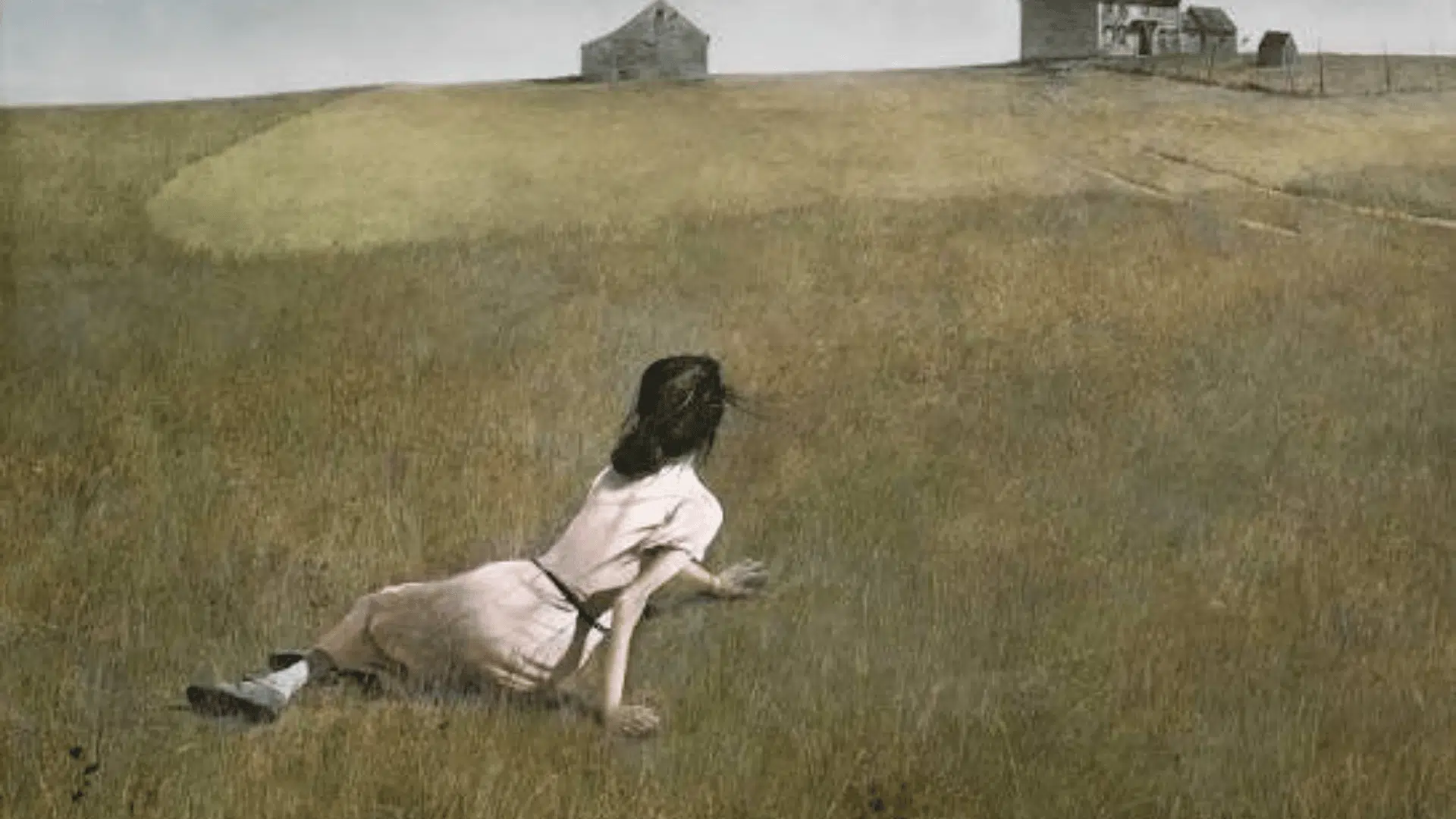
31. Christina’s World

Source: tallengestore
Wyeth shows a woman in a pink dress dragging herself across a vast field toward a distant gray farmhouse.
Christina Olson, who had a degenerative muscular disorder, embodies determination and isolation simultaneously in this deceptively simple scene. The hyper-realistic style and emotional restraint create haunting tension.
- Art Movement: Realism
- Date: 1948
- Medium: Tempera on panel
- Location: Museum of Modern Art, New York
32. Nighthawks

Source: artic.edu
Hopper’s late-night diner glows with harsh fluorescent light against dark city streets. Four isolated figures occupy the space: a couple, a lone man, and a white-uniformed server, none interacting, all lost in private thoughts.
No door appears in the composition, visually trapping customers and viewers in this timeless moment of urban alienation.
- Art Movement: American Realism
- Date: 1942
- Medium: Oil on canvas
- Location: Art Institute of Chicago
33. Portrait of Adele Bloch-Bauer

Source: fineartamerica
Klimt surrounded his subject with shimmering gold leaf and Byzantine-inspired ornamental patterns, leaving only her face and hands uncovered.
Adele emerges from the decorative surface like a sacred icon, her knowing expression contrasting with the abstract geometric shapes.
- Art Movement: Symbolism
- Date: 1907
- Medium: Oil and gold leaf on canvas
- Location: Neue Galerie, New York
34. The Death of Socrates

Source:metmuseum.org
David depicted the philosopher calmly reaching for the cup of hemlock while distraught followers grieve around him in dramatic poses.
Socrates sits upright on his prison bed, one finger pointing heavenward, teaching until his final moment.
- Art Movement: Neoclassicism
- Date: 1787
- Medium: Oil on canvas
- Location: Metropolitan Museum of Art, New York
35. The Fighting Temeraire

Source: MorganMarine
Turner showed the legendary warship that fought at Trafalgar being towed to its final berth by a dark, modern steamboat.
The ghostly white sailing vessel contrasts with the industrial tugboat under a blazing sunset of gold and crimson.
- Art Movement: Romanticism
- Date: 1839
- Medium: Oil on canvas
- Location: National Gallery, London
Each of these masterpieces tells a story of patience, imagination, and human connection. Together, they capture how creativity continues the shape how people see and feel the world.
Other Remarkable Works of Art Through Time
Beyond the most famous masterpieces, countless other works have shaped artistic movements and cultural consciousness.
36. Olympia: Manet’s reclining nude stares directly at viewers with unflinching confidence, challenging traditional ideals of feminine modesty.
37. The Thinker: Rodin’s bronze sculpture shows a man in deep contemplation, chin resting on his hand. Originally part of a larger work about Dante’s Inferno, it became a universal symbol of intellectual struggle.
38. The Kiss (Rodin): Two lovers embrace in marble, their bodies merging into one passionate form. Rodin captured the intensity of romantic love with sensual realism that was both controversial and celebrated.
39. The Gleaners: Millet painted three peasant women bent over, gathering leftover grain after harvest. The monumental treatment of working-class subjects was radical, elevating their labor to heroic dignity.
40. Composition VIII: Kandinsky’s abstract geometric shapes float across the canvas in colorful harmony. Circles, triangles, and lines interact without representing anything from the physical world, making pure visual music.
41. Broadway Boogie Woogie: Mondrian’s grid of yellow, red, and blue rectangles pulses with the energy of New York City streets and jazz rhythms.
42. The Son of Man: Magritte painted a man in a bowler hat with a green apple floating in front of his face. The surreal image questions identity and what we choose to reveal or conceal about ourselves.
43. The Treachery of Images: Magritte painted a pipe with the words “This is not a pipe” beneath it, challenging representation itself.
44. The Third of May 1808: Goya depicted Spanish civilians being executed by French soldiers with brutal honesty. The lantern-lit scene shows war’s horror through one man’s white shirt, making it among the best art of all time.
45. Saturn Devouring His Son: Goya’s nightmarish painting shows the Titan eating his child in grotesque detail. Part of his “Black Paintings,” it expresses humanity’s darkest fears and madness with visceral power.
46. The Ninth Wave: Aivazovsky painted shipwreck survivors clinging to a mast as massive waves tower over them at sunrise.
47. The Sleeping Gypsy: Rousseau painted a lion standing over a sleeping woman in a moonlit desert with mysterious stillness. The naive style and dreamlike atmosphere create an unforgettable scene that defies logical explanation.
48. The Dance: Matisse’s five red figures hold hands in a circle against blue and green. The simplified forms and pure colors celebrate movement and joy with a childlike directness that profoundly influenced modern art.
49. I and the Village: Chagall’s dreamlike canvas layers memories of his Russian-Jewish childhood with fantasy.
50. The Tower of Babel: Bruegel depicted the biblical tower as an enormous spiral structure crawling with construction activity; the painting comments on human ambition, confusion, and the impossibility of reaching heaven through building alone.
51. The Ambassadors: Holbein painted two wealthy men surrounded by symbols of learning, power, and mortality. A distorted skull in the foreground reminds viewers that death comes for everyone, regardless of status or knowledge.
52. The Swing: Fragonard’s rococo masterpiece shows a young woman on a swing, her shoe flying off as a hidden lover watches from below.
53. Café Terrace at Night: Van Gogh painted the glowing yellow café against a deep blue night sky filled with stars. The perspective pulls viewers down the cobblestone street into the warm light and evening atmosphere.
54. Irises: Van Gogh’s garden flowers burst with color and energy in bold, expressive brushstrokes.
55. Sunflowers: Van Gogh’s still life series depicts flowers from blooming to wilting, with thick impasto and golden yellows that make them glow with emotion and light, securing their artistic prominence.
56. The Card Players: Cézanne painted peasants absorbed in their card game with solid, geometric forms.
57. Mont Sainte-Victoire: Cézanne painted this mountain repeatedly, breaking its form into geometric planes of color. His analytical approach to landscape influenced Cubism and changed how artists understood pictorial space.
58. A Bar at the Folies-Bergère: Manet’s barmaid stares at viewers while the mirror behind reflects the crowded music hall. The puzzling reflection doesn’t match the scene we see, creating ambiguity about perspective and reality.
59. Bal du moulin de la Galette: Renoir captured Parisians dancing, drinking, and socializing in dappled sunlight.
60. Luncheon of the Boating Party: Renoir painted his friends relaxing after lunch on a restaurant balcony. The scene glows with light filtering through the awning, capturing a perfect moment of leisure and friendship.
61. The Lacemaker: Vermeer’s tiny painting shows a young woman completely absorbed in her delicate work.
62. The Garden of Love: Rubens painted aristocratic couples strolling through a garden filled with cherubs and classical architecture. The baroque splendor and sensual atmosphere celebrate courtly romance and earthly pleasure.
63. Ophelia: Millais painted Shakespeare’s drowned character floating in a stream surrounded by symbolic flowers. The Pre-Raphaelite detail and tragic beauty made this one of Victorian England’s most beloved images.
64. The Lady of Shalott: Waterhouse depicted Tennyson’s cursed lady drifting in her boat toward Camelot. The romantic medieval setting and doomed heroine exemplify Pre-Raphaelite fascination with legend and beauty, marking it among the best art of all time for literary painting.
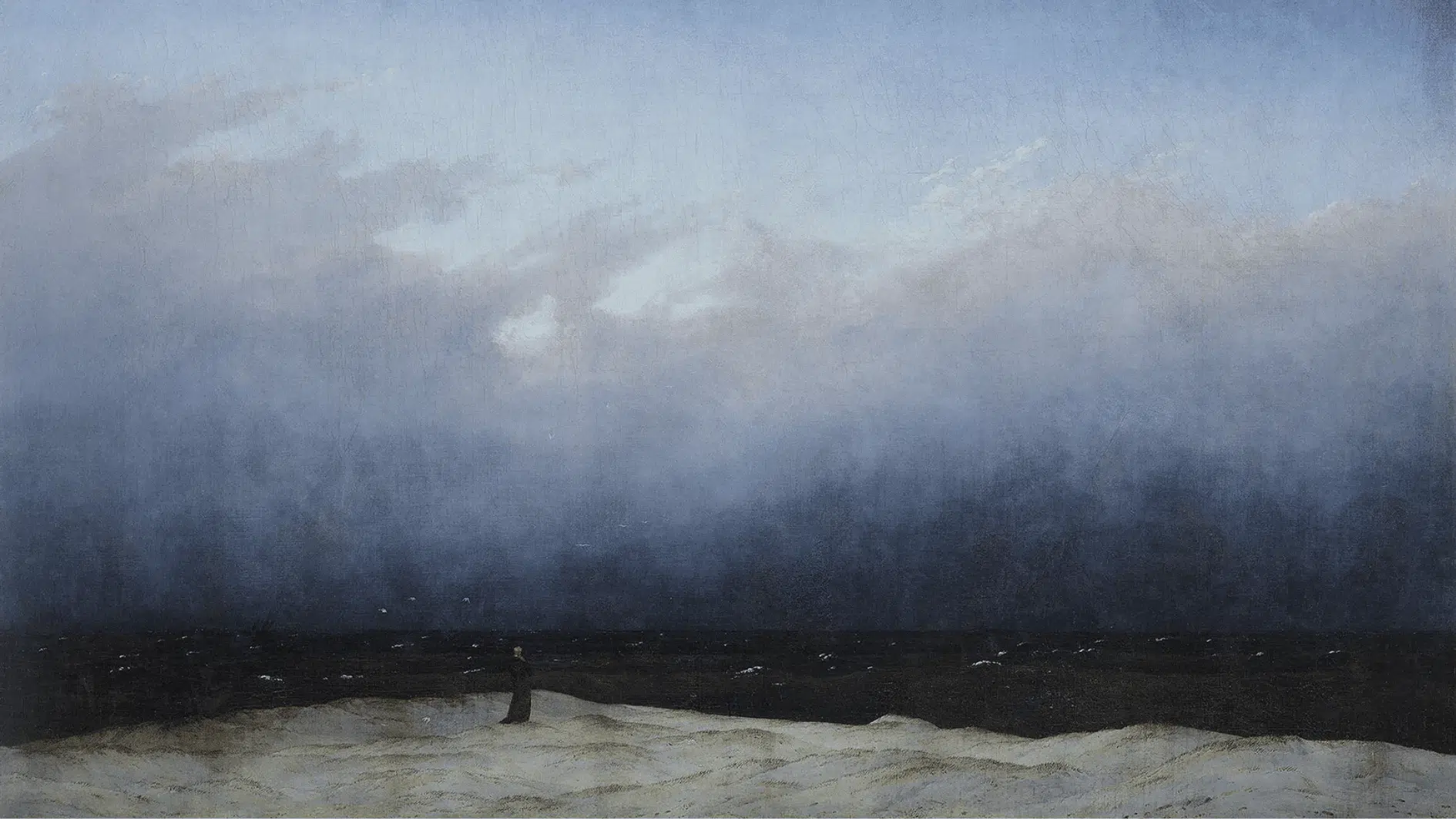
65. Wanderer Above the Sea of Fog: Friedrich painted a man standing on a rocky peak, gazing over misty mountains. The romantic figure contemplating nature’s vastness became an icon of German Romanticism and individual spirituality.
66. The Potato Eaters: Van Gogh’s early work shows peasants sharing a humble meal in dim lamplight. The dark palette and rough figures convey the harsh reality of rural poverty with deep empathy and social conscience.
67. Where Do We Come From? What Are We? Where Are We Going?: Gauguin’s philosophical masterpiece spans three stages of life from infancy to old age. Painted in Tahiti, it combines symbolism with questions about human existence and purpose.
68. Vision After the Sermon: Gauguin depicted Breton women seeing Jacob wrestling with an angel after church. The bold red ground and flattened forms separate the spiritual vision from physical reality.
69. The Artist’s Garden at Vétheuil: Monet painted the garden path leading to his house with colorful flower beds. The perspective draws viewers into the intimate domestic landscape.
70. The Death of Marat: David painted the revolutionary leader murdered in his bath, turning political assassination into classical tragedy. The stark composition and dramatic lighting create a secular martyr scene.
71. The Oath of the Horatii: David’s neoclassical painting shows Roman brothers swearing to fight for their city. The rigid vertical and horizontal lines emphasize duty, honor, and masculine virtue over emotional softness.
72. The Coronation of Napoleon: David’s enormous canvas documents Napoleon crowning himself emperor while the Pope watches. The detailed historical record also serves as propaganda for imperial power and legitimacy.
73. The Raft of Medusa: Géricault’s masterpiece deserves recognition for bringing contemporary scandal to grand historical painting. The pyramid composition of desperate survivors shocked audiences with brutal realism.
74. The Fighting Téméraire: Turner’s meditation on progress shows the old warship towed to demolition. The ghostly vessel, set against modern industry, captures technological change with poetic melancholy.
75. Rain, Steam and Speed: Turner painted a locomotive racing across a bridge through atmospheric haze. The radical technique dissolves solid forms into light and motion, celebrating modernity’s energy.
76. Slave Ship: Turner depicted enslaved people thrown overboard during a storm, their bodies attacked by sea creatures. The violent sea and blood-red sunset create a horrific vision of human cruelty.
77. Chrysanthemums: Monet filled the canvas with a massive bouquet. His bold brushstrokes give the painting energy and life, making it one of the best artworks ever created.
78. Liberty Leading the People: Already mentioned, Delacroix’s bare-breasted Liberty leads citizens over barricades. The painting transformed political upheaval into a romantic allegory.
79. The Massacre at Chios: Delacroix painted Greek families suffering under Ottoman occupation during their war of independence.
80. Women of Algiers: Delacroix depicted North African women in their private quarters with rich color and sensual detail. His orientalist vision influenced later artists, who were fascinated by exotic subjects.
81. Arrangement in Black and Gold: Whistler’s Nocturne shows fireworks over the Thames in abstract strokes and spots. The lawsuit it provoked helped define modern attitudes about artistic freedom.
82. Symphony in White: Whistler painted a woman in white against white, emphasizing tonal relationships. The title’s musical reference shows his belief that painting should work like music, through pure aesthetic harmony.
83. The White Girl: Whistler’s first significant success shows a woman in white holding a lily against a white curtain. Critics debated its meaning while Whistler insisted it had none beyond visual arrangement.
84. The Gross Clinic: Eakins painted a surgeon lecturing during an operation with unflinching medical realism. The dramatic lighting and bloody hands shocked viewers expecting idealized subjects.
85. The Agnew Clinic: Eakins’s later surgical scene shows modern medical practice in a brighter, cleaner setting. The white-gowned doctors reflect changing hospital practices and scientific progress.
86. Max Schmitt in a Single Scull: Eakins painted his friend rowing on the Schuylkill River with precise perspective and atmospheric light. The artist included himself rowing in the middle distance.
87. The Tub: Degas depicted a woman bathing from an unusual high angle. The unconventional viewpoint and intimate subject show his interest in capturing private moments through unexpected perspectives.
88. The Absinthe Drinker: Degas painted a woman and a man sitting isolated at a café table. Their disconnection and blank stares capture urban loneliness and the social problems of alcoholism.
89. The Ballet Class: Degas showed dancers rehearsing under their instructor’s watchful eye. His behind-the-scenes view reveals the hard work beneath performance glamour.
90. Blue Dancers: Degas’s pastel work captures four ballerinas in blue tutus. The cropped composition and unusual angles show his innovative approach to depicting movement.
91. Woman with Chrysanthemums: Degas placed a woman at the edge of an enormous flower arrangement. The unconventional composition reflects Japanese print influence on his work.
92. Luncheon on the Grass: Manet’s scandalous painting shows a nude woman picnicking with dressed men. The brazen modernity and flat painting style make it among the best art of all time for shocking convention.
93. The Fifer: Manet painted a young military musician against a flat background with simplified forms. The lack of modeling and spatial depth referenced Japanese prints and Spanish painting.
94. Nana: Manet depicted a courtesan getting dressed while a gentleman waits in the background. The frank treatment of contemporary sexuality continued his challenge to academic propriety.
95. The Railway: Manet showed a woman and child near the Gare Saint-Lazare with steam obscuring the background: the modern urban subject and cropped composition break from traditional portrait conventions.
96. In the Conservatory: Manet painted a married couple sitting on a bench surrounded by tropical plants. The psychological distance between them suggests complex relationship dynamics beneath the fashionable surface.
97. The Monet Family in Their Garden: Manet depicted his friend Claude Monet with his family in their garden. The outdoor setting and loose brushwork show an impressionist influence on his later style.
98. Carnation, Lily, Lily, Rose: Sargent painted children lighting paper lanterns at twilight in a flower garden. He worked outdoors for months to capture the exact quality of fading light.
99. Madame X: Sargent’s portrait of a society beauty in a black dress caused a scandal. Her pale skin, confident pose, and plunging neckline were considered too provocative for public exhibition.
100. The Daughters of Edward Darley Boit: Sargent painted four sisters in their Paris home with unusual spatial composition. The asymmetric arrangement and mysterious shadows create psychological depth.
101. Lady Agnew of Lochnaw: Sargent captured the Scottish socialite with effortless grace and technical brilliance. The portrait’s success established his reputation as the leading society portraitist.
102. Gassed: Sargent documented World War I soldiers blinded by mustard gas being led to treatment. The frieze-like composition of suffering men creates a powerful anti-war statement.
103. El Jaleo: Sargent painted a flamenco dancer performing while musicians and audience watch from the darkness.
104. A Sunday on La Grande Jatte: Seurat’s pointillist masterpiece shows Parisians relaxing by the Seine. Two years of careful dot application created this scientific approach to color and light.
105. Bathers at Asnières: Seurat’s early large-scale work depicts working-class Parisians relaxing by the river. The simplified forms and careful color relationships anticipate his pointillist technique.
106. The Circus: Seurat’s final painting shows a circus performance with acrobats and riders. The upward-pointing composition and bright colors create a sense of flexible movement through geometric forms.
107. Young Woman Powdering Herself: Seurat painted his mistress applying makeup using the pointillist technique. The intimate domestic scene contrasts with his usual public leisure subjects.
108. The Channel of Gravelines: Seurat applied pointillism to landscape, capturing the French harbor and sea. The technique transforms the scene into shimmering patterns of light and color.
109. The Houses of Parliament: Monet painted the London landmark repeatedly in different weather and light conditions. The series explores how atmosphere transforms solid architecture into colored mist.
110. Rouen Cathedral Series: Monet depicted the cathedral facade at different times of day. The serial approach shows how changing light completely changed our perception of form.
111. Haystacks: Monet’s famous series captures the same haystack under varying conditions. The repetition demonstrates that light and atmosphere matter more than subject matter itself.
112. Poplars: Monet painted rows of poplar trees along the Epte River in shifting light. The vertical forms and reflections create rhythmic patterns across the canvas series.
113. Woman with a Parasol: Monet captured his wife and son on a windy hillside with spontaneous brushwork. The upward viewpoint and windblown dress convey an immediate sensory experience.
114. The Magpie: Monet painted a winter landscape with a single bird on a fence. The subtle color variations in snow and shadow show his mastery of atmospheric effects.
115. The Argenteuil Bridge: Monet depicted the modern iron bridge with loose, broken brushstrokes. The industrial structure becomes part of the natural landscape through impressionist handling.
116. Wild Poppies: Monet showed his wife and son walking through a poppy field. The red flowers and blue sky create a lively color contrast while capturing a fleeting summer moment.
117. La Grenouillère: Monet painted this popular riverside resort alongside Renoir. The sketchy technique and broken reflections capture modern leisure and changing light on water.
118. The Beach at Sainte-Adresse: Monet depicted the Normandy coast with boats and figures under a cloudy sky. Bright flags and striped awnings add decorative color patterns to the beach scene.
119. Garden at Sainte-Adresse: Monet painted his family’s garden overlooking the sea with vivid flowers in the foreground. The high viewpoint and bright colors create a Japanese print-like composition.
120. The Luncheon: Monet showed his family’s abandoned lunch table in dappled garden shade. The intimate domestic scene focuses on light effects rather than human drama.
121. Camille on Her Deathbed: Monet painted his dying wife in somber tones. Even in grief, he studied how death changes the colors of flesh, demonstrating his commitment to visual truth.
Why These Works Still Resonate Today?
These greatest paintings of all time continue to captivate audiences because they speak to human experiences.
Technical brilliance also keeps viewers coming back. The way Vermeer captured light or how Michelangelo understood anatomy still amazes us.
Cultural impact matters too. Works like Guernica or The Scream became visual shorthand for complex ideas. They entered our collective consciousness, referenced in everything from movies to memes.
Innovation keeps them relevant as well. Finally, mystery draws us in.
Many works raise questions we can’t fully answer. That ambiguity invites endless interpretation, making each viewing a fresh experience.
Tips from the Art Enthusiast Community
Members of the art community share valuable yet straightforward insights drawn from the greatest paintings of all time and the best art, helping others see art through new perspectives and appreciate the stories behind every masterpiece.
Here are a few discussion forums:
Check reddit
Check watercoolertrivia
Q1:What defines great art across different styles and times?
Great art reflects change and continuity, reacting to past styles and cultural contexts. It sustains deep discussion through its complexity or contextual richness, whether simple or intricate in form.
Q2:Where can I find reliable online resources to learn art history in depth?
Smarthistory is a top-recommended expert-led channel offering college-level art history education, with complementary essays available online. For podcasts, the Accession podcast is highly regarded.
Q3:What style is often seen in vintage-looking digital poster art?
Commonly identified styles include Futurism, Bauhaus, and Art Deco, each with distinct historical design traits rooted in early 20th-century movements.
Q4:Who is known as the father of Impressionism?
Claude Monet is widely recognized as the father of Impressionism for pioneering this influential painting style.
Q5:Which city in southern France was home to Van Gogh when he created over 300 artworks?
Vincent van Gogh lived in Arles between 1888 and 1889, producing many of his famous works there.
Q6:What’s the expensive blue pigment historically reserved for painting the Virgin Mary’s robes?
Ultramarine, made from lapis lazuli, was a costly pigment historically used mainly for depictions of the Virgin Mary.
Q7: What is the art term for the contrast of light and dark in a painting?
“Chiaroscuro” describes the use of strong contrasts between light and shadow in artworks, particularly from the Renaissance and Baroque periods.
These shared thoughts remind us that art is best enjoyed together. The greatest paintings of all time and other arts continue to inspire connection, creativity, and conversation among those who love them most.
Wrapping It Up
The greatest paintings of all time prove that art transcends its moment of creation.
From Renaissance chapels to modern galleries, these works continue speaking across generations because they capture something fundamental about being human.
What makes them unforgettable isn’t just technical skill or historical importance, but it’s their ability to make viewers feel something real.