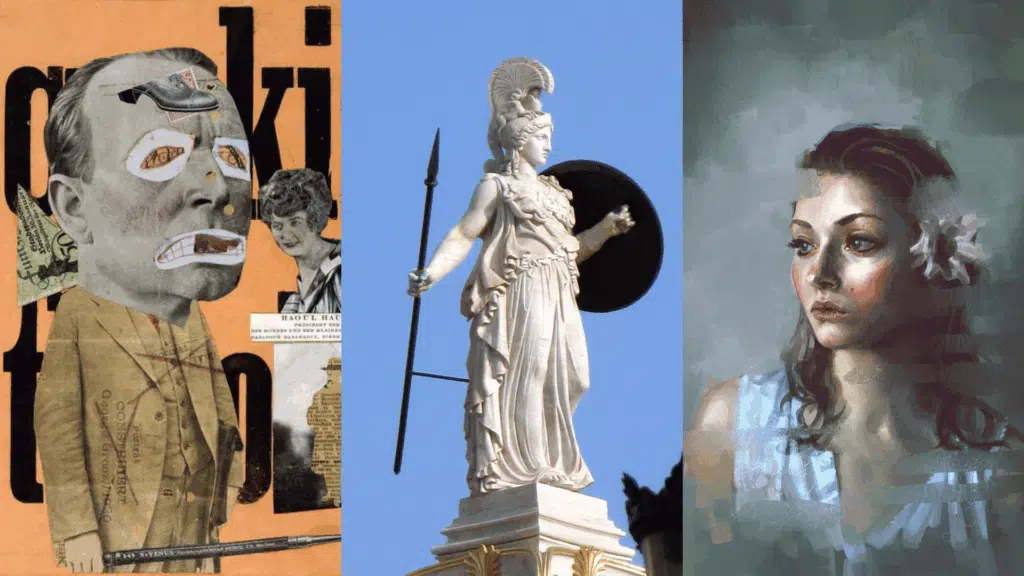
Art styles represent distinct visual approaches that artists use to create and communicate their work. Think of them as visual languages, each with its own rules, techniques, and personality.
From Renaissance realism to abstract expressionism, these styles have shaped how people express ideas, capture moments, and see the world differently.
Knowing about popular art styles that changed how people create and view art is important. Readers will learn about famous painting styles, including Impressionism, Cubism, Realism, and more!
Understanding art styles opens up a whole new way to appreciate visual creativity, so let’s get started.
Ancient and Classical Art Styles
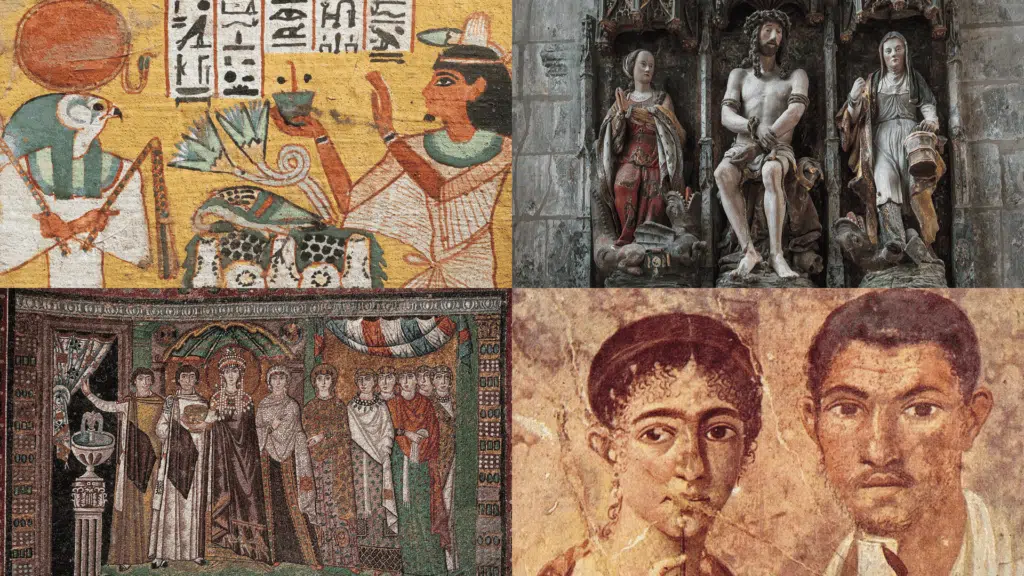
These foundational art styles established principles that influenced Western art for millennia. These techniques in sculpture, architecture, and painting created lasting legacies that continue to inspire popular art styles today.
1. Ancient Egyptian Art
Ancient Egyptian art served religious and ceremonial purposes, depicting gods, pharaohs, and the afterlife with strict symbolic conventions.
- Key Characteristics: Hierarchical scale, composite view, flat figures, symbolic colors, formal poses
- Notable Artists: Unknown temple artisans, royal court painters, tomb sculptors
- Forms of Composition: Tomb paintings, temple reliefs, papyrus scrolls, funerary masks, colossal statues
2. Classical Greek Art
Classical Greek art celebrated the human form through idealized representations of beauty, proportion, and balance.
This period emphasized naturalism while still maintaining a vision of humanity that embodied philosophical concepts of perfection.
- Key Characteristics: Idealized forms, contrapposto stance, mathematical proportions, naturalistic drapery
- Notable Artists: Phidias, Praxiteles, Polykleitos, Myron, Apelles
- Forms of Composition: Marble sculptures, bronze statues, temple friezes, pottery decoration, athletic figures
3. Roman Art
Roman art blended Greek influences with practical Roman values, emphasizing realism and documentation of actual people and events.
Unlike Greek idealization, Roman portraits captured individual features, including imperfections and age.
- Key Characteristics: Realistic portraiture, verism, narrative reliefs, detailed mosaics,
- Notable Artists: Unknown sculptors and mosaicists, imperial court artists, provincial workshop masters
- Forms of Composition: Portrait busts, historical reliefs, floor mosaics, wall frescoes, triumphal arches
4. Byzantine Art
Byzantine art merged Christian symbolism with Eastern influences, creating a distinctive style focused on spiritual rather than physical reality.
- Key Characteristics: Gold leaf backgrounds, frontal poses, stylized figures, religious iconography,
- Notable Artists: Anonymous icon painters, monastery workshop masters, imperial court mosaicists
- Forms of Composition: Religious icons, church mosaics, illuminated manuscripts, portable devotional panels
5. Gothic Art
Gothic art emerged from medieval cathedrals, reaching skyward with pointed arches and stained glass that changed light into divine radiance.
This style balanced architectural innovation with narrative storytelling through sculpture and illuminated manuscripts.
- Key Characteristics: Elongated figures, pointed arches, stained glass, intricate detail, vertical emphasis
- Notable Artists: Giotto di Bondone, Simone Martini, Limbourg Brothers, anonymous cathedral sculptors
- Forms of Composition: Cathedral sculptures, stained glass windows, illuminated manuscripts, altar paintings,
Renaissance and Early Modern Movement Art Styles
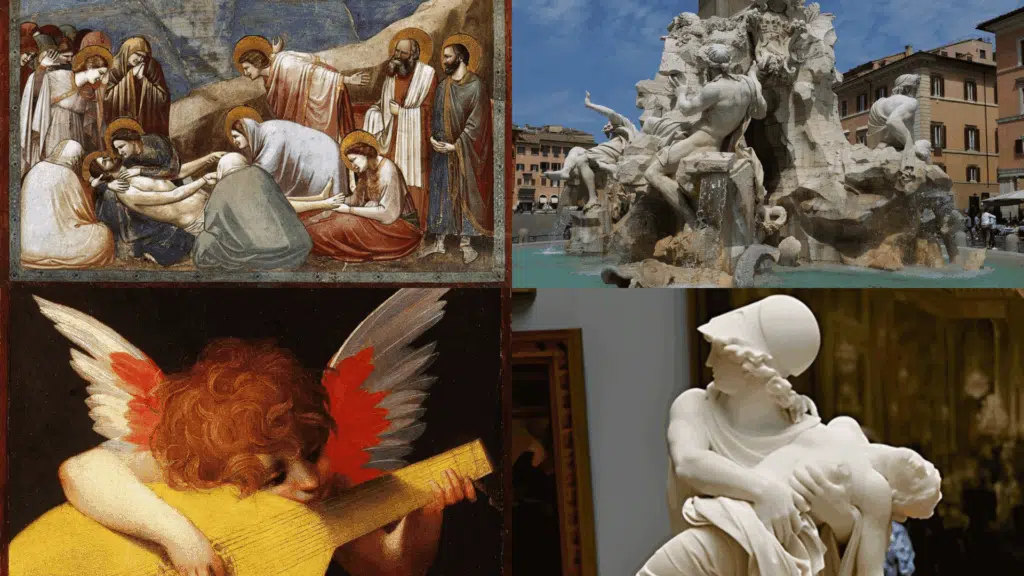
These movements emphasized individual creativity, scientific observation, and the dignity of human achievement. Artists rediscovered classical principles while developing new techniques like linear perspective and oil painting.
6. Renaissance Art
Renaissance art revolutionized visual representation through mathematical perspective, anatomical accuracy, and balanced composition.
- Key Characteristics: Linear perspective, anatomical accuracy, balanced composition, sfumato, chiaroscuro
- Notable Artists: Leonardo da Vinci, Michelangelo, Raphael, Sandro Botticelli, Titian, Donatello
- Forms of Composition: Religious altarpieces, frescoes, portraits, mythological scenes, sculptural figures
7. Mannerism
Mannerism emerged as artists deliberately distorted Renaissance harmony to create tension and emotional complexity.
This refined style prioritized artificial grace and intellectual complexity over naturalistic representation, appealing to educated courtly audiences.
- Key Characteristics: Elongated figures, twisted poses, unusual colors, crowded compositions, spatial ambiguity
- Notable Artists: El Greco, Parmigianino, Jacopo Pontormo, Bronzino, Giuseppe Arcimboldo, Tintoretto
- Forms of Composition: Court portraits, religious paintings, allegorical scenes, mythological subjects
8. Baroque
Baroque art exploded with drama, movement, and emotional intensity designed to overwhelm the senses.
This style served both Catholic Counter-Reformation goals and absolutist monarchies seeking to display power and grandeur.
- Key Characteristics: Dramatic lighting, dynamic movement, emotional intensity, rich colors
- Notable Artists: Caravaggio, Peter Paul Rubens, Rembrandt, Gian Lorenzo Bernini, Diego Velázquez
- Forms of Composition: Religious scenes, portraits, mythological dramas, still lifes, sculptural fountains
9. Rococo
Rococo accepted lightness, grace, and decorative charm, flourishing in French salons and boudoirs, where it celebrated beauty, pleasure, and the carefree pleasures of elite society.
- Key Characteristics: Pastel colors, ornate decoration, playful themes, curved lines, intimate scale
- Notable Artists: Jean-Honoré Fragonard, François Boucher, Antoine Watteau, Jean-Antoine Houdon
- Forms of Composition: Pastoral scenes, romantic encounters, decorative panels, porcelain figures
10. Neoclassicism
This style aligned with Enlightenment values and revolutionary ideals, presenting classical themes as models for contemporary behavior.
- Key Characteristics: Classical subjects, clear lines, balanced composition, restrained emotion, moral themes
- Notable Artists: Jacques-Louis David, Jean-Auguste-Dominique Ingres, Antonio Canova, Angelica Kauffman,
- Forms of Composition: Historical paintings, heroic portraits, mythological scenes, sculptural reliefs,
19th-Century Artistic Revolutions
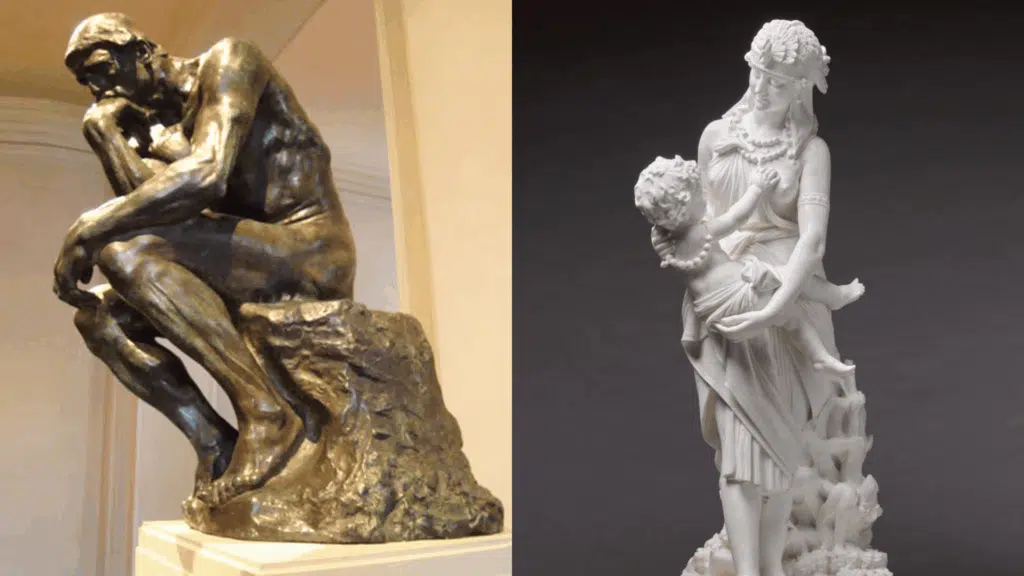
Emotion, realism, and the reaction against academic art defined this changing century. These movements laid groundwork for modern art’s break from traditional representation.
11. Romanticism
Romanticism lifted emotion, imagination, and individual experience over rational thought and classical rules. This movement valued spontaneity, passion, and the mysterious forces of nature and human psychology.
- Key Characteristics: Emotional intensity, dramatic landscapes, exotic subjects, nature’s power, vivid colors
- Notable Artists: Caspar David Friedrich, Eugène Delacroix, J.M.W. Turner, Francisco Goya, Théodore Géricault
- Forms of Composition: Sublime landscapes, historical dramas, literary subjects, Oriental scenes, sculptures
12. Realism
Realism rejected idealization to depict everyday life and ordinary people with unflinching honesty. This movement insisted that common subjects deserved serious artistic treatment, challenging academic hierarchies.
- Key Characteristics: Everyday subjects, unidealized figures, contemporary settings, social commentary
- Notable Artists: Gustave Courbet, Jean-François Millet, Honoré Daumier, Rosa Bonheur, Ilya Repin
- Forms of Composition: Working-class scenes, rural labor, urban life, social critique paintings and sculptures
Early 20th-Century Modernist Movement Art Styles
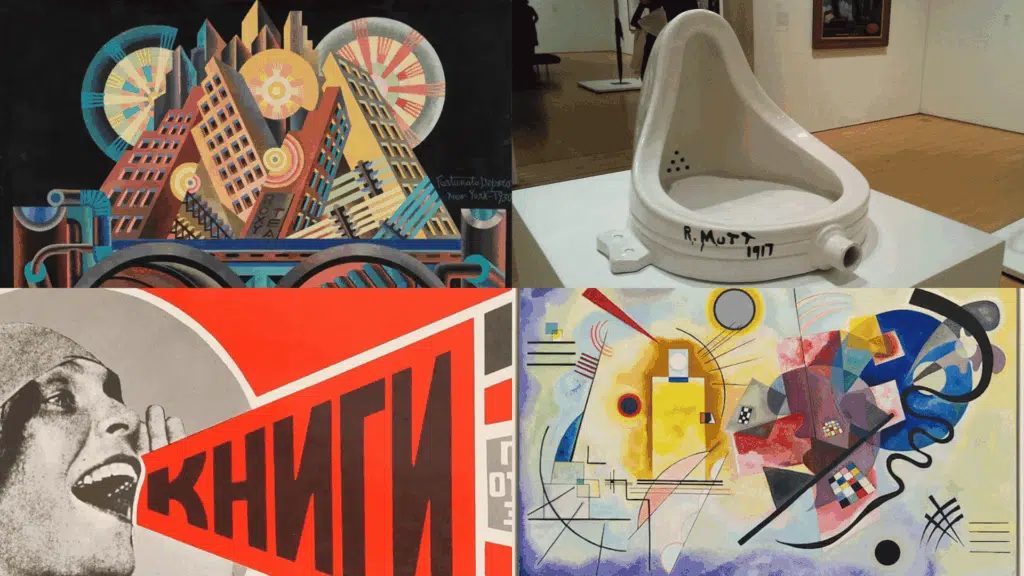
Breaking traditional form through innovation and abstraction, these movements radically reimagined art’s purpose and possibilities. These experimental approaches rejected representational accuracy in favor of pure form, color, and conceptual ideas.
13. Futurism
Futurism celebrated speed, technology, and the ever-changing movement of modern industrial life. Artists’ fragmented forms to suggest motion and energy, capturing the kinetic experience of machines, cities, and modern warfare.
- Key Characteristics: Dynamic movement, fragmented forms, speed lines, mechanical subjects
- Notable Artists: Umberto Boccioni, Giacomo Balla, Gino Severini, Carlo Carrà, Luigi Russolo
- Forms of Composition: Moving figures, vehicles, urban scenes, abstract motion studies, manifestos
14. Constructivism
Constructivism merged art with industrial design and social purpose, creating geometric compositions from modern materials.
This revolutionary movement believed art should serve the collective good and reflect industrial society’s rational organization.
- Key Characteristics: Geometric forms, industrial materials, bold colors, utilitarian design, socialist themes
- Notable Artists: Vladimir Tatlin, Alexander Rodchenko, El Lissitzky, Lyubov Popova, Varvara Stepanova
- Forms of Composition: Propaganda posters, architectural models, stage designs, photomontages
15. De Stijl
De Stijl reduced visual elements to their essence using only primary colors, black, white, and geometric forms. Artists sought universal harmony through mathematical precision and asymmetrical balance.
This Dutch movement influenced architecture, furniture, and graphic design, promoting spiritual order through radical simplification.
- Key Characteristics: Primary colors, black and white, geometric rectangles, asymmetrical balance, reduction
- Notable Artists: Piet Mondrian, Theo van Doesburg, Gerrit Rietveld, Vilmos Huszár, Bart van der Leck
- Forms of Composition: Abstract grid paintings, architectural designs, furniture, typography, interior designs
16. Dada
Dada rejected all artistic conventions and rational thought following World War I’s devastation. This anarchic movement mocked bourgeois culture and traditional visuals, questioning what could even be considered art.
- Key Characteristics: Anti-art stance, readymades, chance operations, absurdity, collage, rejection of logic
- Notable Artists: Marcel Duchamp, Man Ray, Hannah Höch, Francis Picabia, Kurt Schwitters, Tristan Tzara
- Forms of Composition: Readymades, photomontages, collages, nonsense poetry, found object assemblages
17. Bauhaus
Bauhaus unified fine art, craft, and technology under functionalist principles that emphasized simplicity and practicality.
- Key Characteristics: Form follows function, geometric simplicity, industrial materials, sans-serif typography
- Notable Artists: Walter Gropius, Paul Klee, Wassily Kandinsky, Josef Albers, László Moholy-Nagy, Marcel Breuer
- Forms of Composition: Architecture, furniture design, typography, textile patterns, industrial products
18. Art Deco
This decorative style combined modern materials like chrome and glass with exotic influences and streamlined forms.
Art Deco celebrated technological progress and cosmopolitan grace through bold colors, symmetrical designs, and lavish ornamentation.
- Key Characteristics: Geometric patterns, symmetrical designs, luxurious materials, streamlined forms
- Notable Artists: Tamara de Lempicka, Erté, A.M. Cassandre, René Lalique, Clarice Cliff
- Forms of Composition: Posters, architecture, jewelry, furniture, fashion illustrations, skyscraper designs
19. Symbolism
Symbolism emerged as artists moved away from depicting literal reality to express ideas through metaphor and suggestion. This movement used symbolic imagery, dreams, and mystical themes rather than external appearances.
- Key Characteristics: Symbolic imagery, dreamlike atmosphere, mystical themes
- Notable Artists: Gustave Moreau, Odilon Redon, Pierre Puvis de Chavannes, Edvard Munch, Arnold Böcklin
- Forms of Composition: Allegorical paintings, mythological subjects, portraits with symbolic elements
20. Luminism
Luminism focused on capturing precise effects of light and atmosphere in landscapes through smooth, almost invisible brushwork.
This American movement emphasized serene, contemplative scenes with careful attention to how light changes water, sky, and land.
- Key Characteristics: Smooth brushwork, atmospheric light effects, horizontal compositions, tranquil scenes
- Notable Artists: Fitz Henry Lane, Martin Johnson Heade, John Frederick Kensett, Sanford Robinson Gifford
- Forms of Composition: Coastal scenes, harbor views, luminous skies, reflective water surfaces
Mid- to Late 20th-Century Abstraction Styles
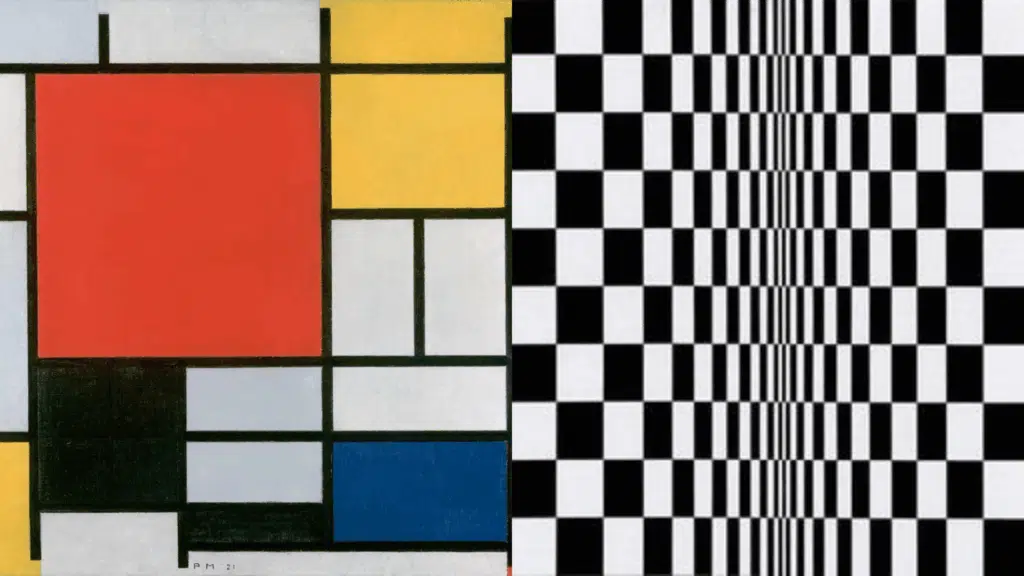
Artists reduced visual elements to their fundamental components or prioritized ideas over aesthetic objects. These movements questioned materiality, perception, and the very nature of artistic experience.
21. Minimalism
Minimalism stripped art to important geometric forms and industrial materials, removing personal expression and symbolic content.
This reductive approach focused attention on space, light, and the phenomenological experience of encountering objects.
- Key Characteristics: Simple geometric forms, industrial materials, repetition, neutral colors
- Notable Artists: Donald Judd, Dan Flavin, Carl Andre, Agnes Martin, Sol LeWitt, Frank Stella
- Forms of Composition: Cubic structures, fluorescent light installations, floor grids, serial paintings, wall reliefs
22. Op Art
Op Art created optical illusions and visual effects through precise geometric patterns that seemed to vibrate, pulse, or move. These perceptual experiments changed static surfaces into dynamic visual experiences.
- Key Characteristics: Geometric patterns, optical illusions, black and white contrasts, vibrating effects
- Notable Artists: Bridget Riley, Victor Vasarely, Jesús Rafael Soto, Richard Anuszkiewicz, Carlos Cruz-Diez
- Forms of Composition: Striped paintings, concentric circles, warped grids, color field experiments
23. Conceptual Art
Conceptual Art prioritized ideas over visual or material qualities, arguing that the concept itself constitutes the artwork.
- Key Characteristics: Idea-based, dematerialization, text as art, instructions, documentation, anti-commercial
- Notable Artists: Sol LeWitt, Joseph Kosuth, Lawrence Weiner
- Forms of Composition: Text pieces, instruction sets, photographic documentation, performances, proposals
Postmodern and Contemporary Movement Art Styles
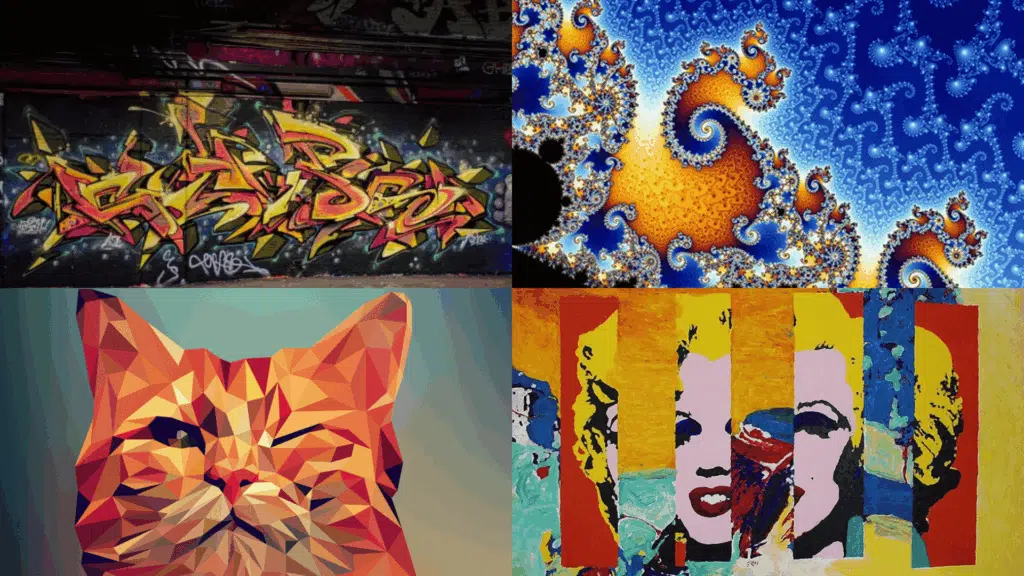
Pluralism, mixed media, and global visual culture characterize this diverse era of artistic production. These movements reflect globalization, the digital revolution, and the collapse of hierarchies between high and low culture.
24. Postmodernism
Postmodernism rejected modernist purity by mixing styles, appropriating imagery, and accepting contradiction and irony.
Artists challenged the idea of originality, artistic genius, and universal truths through pastiche and cultural critique.
- Key Characteristics: Appropriation, irony, mixed styles, cultural critique, rejection of originality
- Notable Artists: Cindy Sherman, Jeff Koons, Barbara Kruger, Jean-Michel Basquiat, Sherrie Levine, David Salle
- Forms of Composition: Photographic tableaux, text-image combinations, neo-expressionist paintings
25. Street Art / Graffiti Art
Street art changed urban spaces into public galleries using spray paint, stencils, and paste-ups outside institutional contexts.
- Key Characteristics: Urban locations, spray paint, stencils, bold graphics, social commentary
- Notable Artists: Banksy, Jean-Michel Basquiat, Keith Haring, Shepard Fairey, Os Gemeos, Lady Pink
- Forms of Composition: Wall murals, tags, stencil art, paste-ups, installations, commissioned public works
26. Digital Art
Digital art employs computers, software, and algorithms as primary creative tools, expanding artistic possibilities beyond traditional media.
This technologically driven medium continues to progress with advances in software, artificial intelligence, and digital distribution platforms.
- Key Characteristics: Computer-generated, pixel-based, algorithmic processes, virtual environments
- Notable Artists: Beeple, Refik Anadol, Jenny Holzer, Rafael Lozano-Hemmer, Casey Reas, Vera Molnár
- Forms of Composition: Digital paintings, generative art, NFTs, data visualizations, virtual reality experiences
27. New Media Art
New Media Art explores emerging technologies, including video, the internet, biotechnology, and artificial intelligence, as artistic media.
This experimental field constantly adapts to technological innovation, investigating how digital tools reshape human experience and communication.
- Key Characteristics: Technology-based, interactive, networked, time-based, participatory, experimental
- Notable Artists: Nam June Paik, Bill Viola, Cao Fei, Hito Steyerl, Trevor Paglen, Lynn Hershman Leeson
- Forms of Composition: Video installations, net art, interactive websites, social media projects, AI collaborations
Environmental, Spatial, and Experiential Art Styles
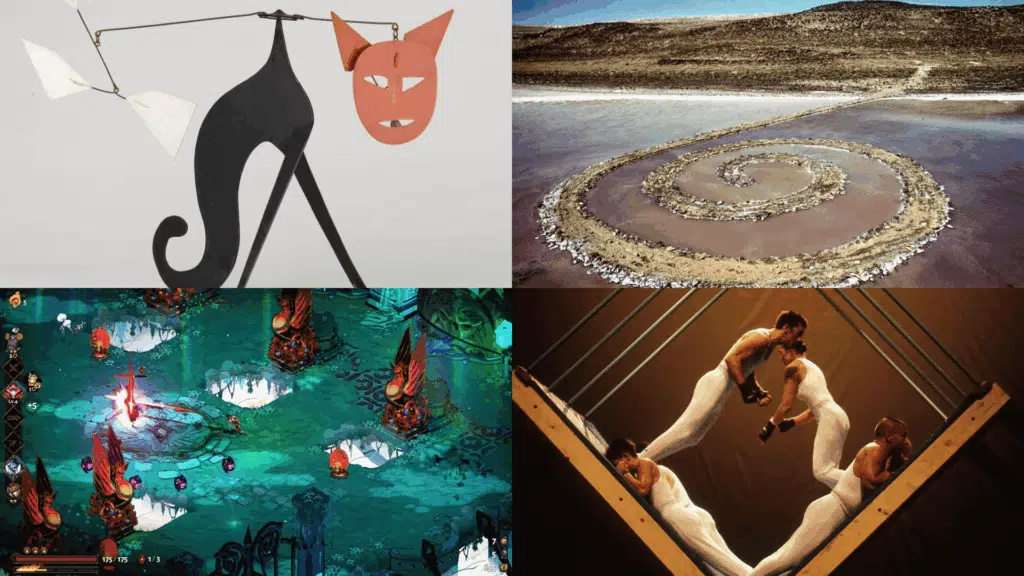
Art that changes space, environment, or viewer experience extends beyond traditional objects into immersive encounters. Artists create temporal works that engage bodies, landscapes, and social situations in this art style.
28. Installation Art
Installation art changes entire spaces into immersive environments that viewers enter and experience physically. This form emphasizes spatial relationships and viewer participation over singular objects meant for contemplation.
- Key Characteristics: Site-specific, mixed media, spatial changes
- Notable Artists: Yayoi Kusama, Olafur Eliasson, Ai Weiwei, Ernesto Neto, Kara Walker, Chiharu Shiota
- Forms of Composition: Room-sized environments, multimedia assemblages, mirrored infinity rooms
29. Performance Art
Performance art uses the artist’s body and actions as the primary medium, creating temporal experiences that exist only in their execution.
This ephemeral form prioritizes presence, process, and documentation over permanent objects.
- Key Characteristics: Live action, body as medium, temporal nature, audience interaction, documentation
- Notable Artists: Marina Abramović, Yoko Ono, Chris Burden, Ana Mendieta, Tehching Hsieh, Tino Sehgal
- Forms of Composition: Endurance pieces, interactive rituals, public interventions, durational actions
30. Land Art / Earthworks
This movement rejected gallery spaces and art commodification while addressing ecological awareness and humanity’s relationship with nature.
- Key Characteristics: Natural materials, monumental scale, remote locations, environmental integration
- Notable Artists: Robert Smithson, Christo and Jeanne-Claude, Andy Goldsworthy, Nancy Holt, Michael Heizer
- Forms of Composition: Earthen spirals, wrapped landscapes, stone circles, desert interventions, walking paths
31. Kinetic Art
Kinetic art incorporates actual movement through motors, wind, magnetic forces, or viewer interaction. This form looks at motion itself as an artistic medium while engaging physics, engineering, and viewer participation.
- Key Characteristics: Physical movement, mechanical elements, viewer interaction, motorized components
- Notable Artists: Alexander Calder, Jean Tinguely, Naum Gabo, Yaacov Agam, Jesús Rafael Soto, George Rickey
- Forms of Composition: Mobiles, mechanical sculptures, motorized assemblages, interactive installations
32. Video Art
Video art employs recorded moving images as an artistic medium, distinct from cinema through experimental approaches and gallery presentation.
This form examines the medium’s different properties, including duration, repetition, and electronic manipulation.
- Key Characteristics: Moving images, time-based, non-narrative structures, experimental editing
- Notable Artists: Bill Viola, Nam June Paik, Pipilotti Rist, Shirin Neshat, Gary Hill, Bruce Nauman
- Forms of Composition: Single-channel videos, multi-screen installations, video sculptures, projection mapping
Material-Based Art Styles and Craft Traditions
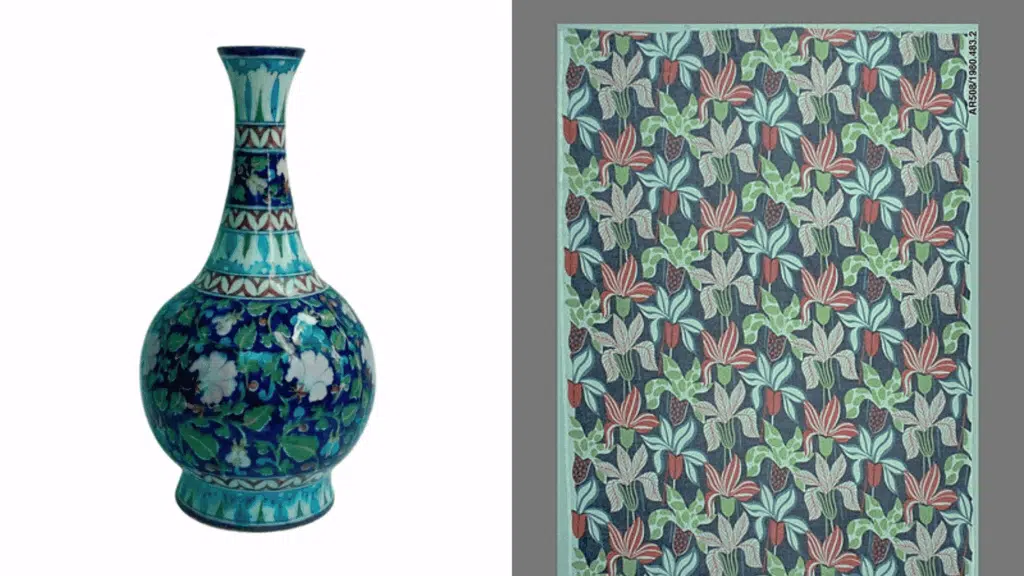
Examining texture, materials, and hybrid practices, these forms change traditional craft techniques to fine art status. Artists investigate material properties while blurring boundaries between functional objects and artistic expressions.
33. Ceramic Art
Ceramic art changes clay through fire into sculptural forms, functional vessels, and conceptual installations. While historically viewed as craft, ceramics have become one of the popular art styles accepted by contemporary artists.
- Key Characteristics: Clay as medium, firing processes, glazing techniques, surface textures.
- Notable Artists: Peter Voulkos, Beatrice Wood, Grayson Perry, Magdalene Odundo.
- Forms of Composition: Sculptural vessels, abstract forms, figurative sculptures, architectural ceramics.
34. Textile Art
Textile art employs fabric, fiber, and thread-based techniques to create artworks that range from wall hangings to sculptural installations.
This medium is known as one of the most popular art styles that challenges its historical dismissal as “women’s work.”
- Key Characteristics: Fiber materials, weaving techniques, textile processes, pattern, and texture.
- Notable Artists: Anni Albers, Faith Ringgold, Sheila Hicks, El Anatsui, Sanford Biggers, Louise Bourgeois.
- Forms of Composition: Wall hangings, quilts, woven tapestries, fiber sculptures, embroidered narratives.
35. Collage and Assemblage
Collage and assemblage combine diverse materials, found objects, and images into unified compositions that celebrate juxtaposition and change.
This additive process democratizes art-making while commenting on consumer culture and visual overload.
- Key Characteristics: Found materials, layering, juxtaposition, mixed media, changing of objects, recycling.
- Notable Artists: Pablo Picasso, Kurt Schwitters, Robert Rauschenberg, Joseph Cornell, Romare Bearden.
- Forms of Composition: Paper collages, photomontages, three-dimensional assemblages, and shadow boxes.
How to Identify Different Art Styles?
Wondering which art style you’re looking at? Use these simple clues to identify popular art styles and famous painting styles quickly.
- Colors tell the story: Impressionism uses soft, light tones, Pop Art features bold, bright colors, and Expressionism shows dark, intense hues.
- Shapes matter: Cubism breaks objects into geometric forms, Art Nouveau flows with curved lines, and Minimalism keeps everything simple.
- Subject reveals style: Realism depicts everyday life accurately, Surrealism creates dream-like scenes, and Abstract shows no recognizable objects.
- Time periods help: Renaissance (1400s-1600s), Impressionism (1860s), Pop Art (1950s-60s), each has distinct eras.
- Brushstrokes give hints: Smooth, detailed strokes suggest Realism, while visible, energetic strokes indicate Impressionism or Expressionism.
Use these simple tips next time you visit a museum or gallery. You’ll quickly recognize different art styles and impress your friends with your art knowledge. Start practicing today and become an art style expert!
The Future of Art Styles in a Digital World
Technology continues to reshape how artists create and share their work. Digital tools now allow creators to blend traditional and popular art styles with cutting-edge software.
Artificial intelligence generates new images, virtual reality creates immersive galleries, and NFTs change how people collect art.
Social media platforms bring global audiences to diverse artistic movements instantly, and young artists experiment freely, mixing Renaissance techniques with digital filters or combining street art with augmented reality.
This technological revolution doesn’t replace historical movements but it expands creative possibilities. The digital age offers unprecedented freedom for artistic innovation and cultural exchange.
Wrapping It Up
Now you know the major art styles that shaped creative history. From Impressionism’s soft brushstrokes to Pop Art’s bold colors, each famous painting style tells its own story.
Understanding these popular art styles makes visiting museums more enjoyable and helps you appreciate artwork better. You can now identify different styles by looking at colors, shapes, and techniques.
Keep visiting galleries and art books to deepen your knowledge and find your favorite art styles.